






How to Choose the Right NVQ Level for Your Career Stage
Choosing the right NVQ level is not simply a matter of selecting the highest qualification available. The correct level should reflect the work you currently perform, the decisions you make and the competence you can demonstrate.
A candidate with many years of experience may still be working at an operative level. Another person with less time in the industry may already manage teams, resources or complex projects. Job titles can also be misleading because employers use terms such as supervisor, manager and team leader differently.
The most reliable approach is to compare your real responsibilities with the occupational requirements of the qualification.
Why the NVQ Level Matters
An NVQ is a competence-based qualification. Candidates normally demonstrate their skills and knowledge through workplace evidence, assessor questioning, observation and professional discussion.
As the level increases, qualifications generally involve greater:
Occupational complexity
Independence and autonomy
Decision-making responsibility
Technical or professional knowledge
Responsibility for people and resources
Influence over workplace systems
Accountability for outcomes
The official GOV.UK qualification-level guide places NVQs within the wider regulated qualifications framework from Level 1 through Level 7.
These framework comparisons show the difficulty of a qualification. They do not mean that qualifications at the same level contain identical content or serve the same occupational purpose.
For example, a Level 6 NVQ and a bachelor’s degree sit at the same framework level, but they are not the same qualification. One may assess occupational competence through workplace evidence, while the other normally follows an academic programme.
What the Different NVQ Levels Usually Represent
The meaning of each level depends on the occupation. The following descriptions should be treated as general guidance rather than universal job-title rules.
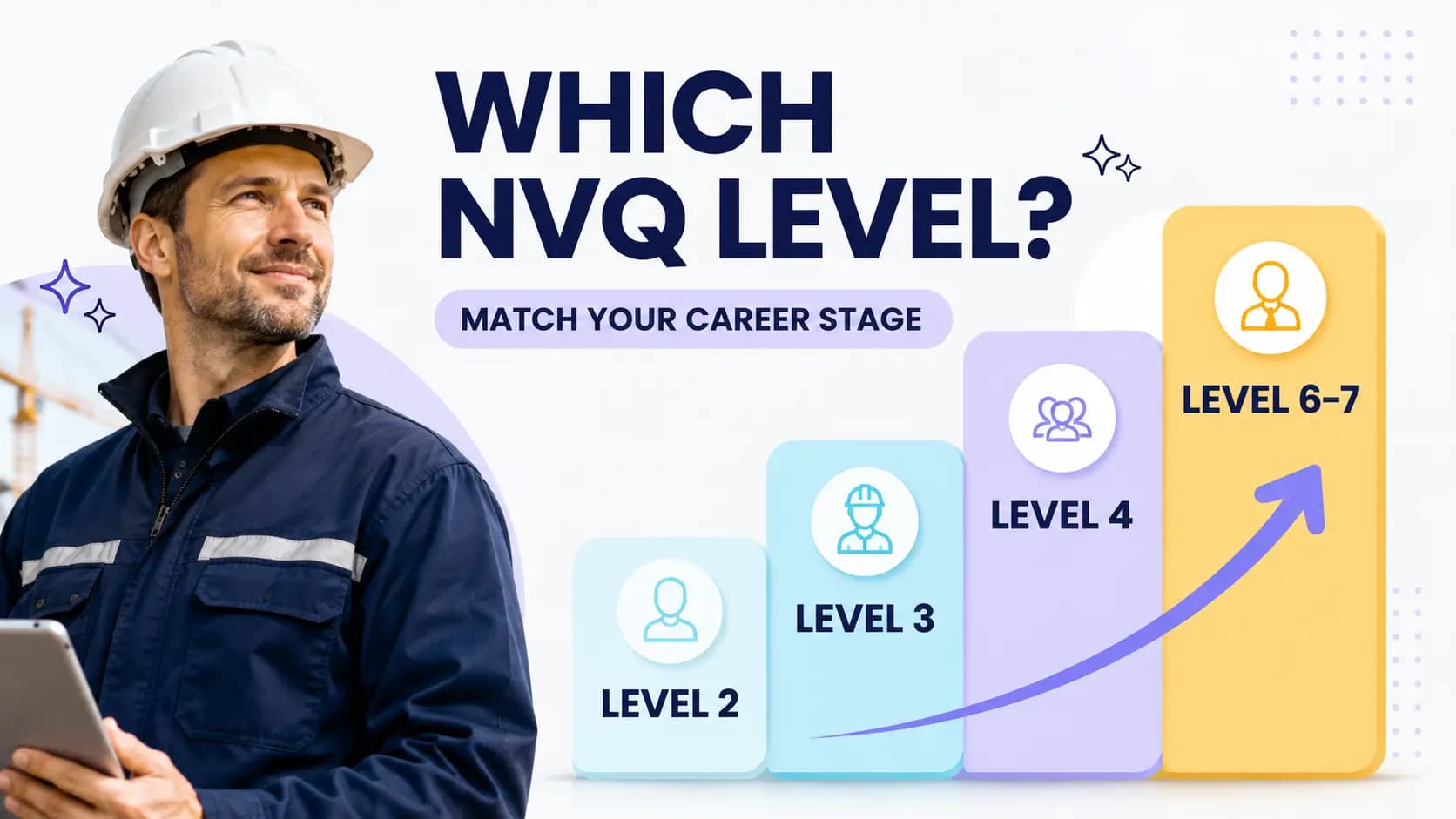
Levels 1 and 2: Developing and skilled operational competence
Level 1 qualifications usually relate to basic occupational activities completed under guidance or supervision.
Candidates may be expected to:
Follow established instructions
Complete routine activities
Use basic occupational knowledge
Work safely within clearly defined limits
Ask for help when situations fall outside their responsibility
Level 2 normally represents greater occupational competence. It is common in skilled operative, trade and service roles where a person completes a range of tasks with some independence.
A Level 2 candidate may:
Select and use appropriate tools or resources
Complete recognised occupational tasks
Interpret basic work information
Check the quality of their own work
Respond to routine problems
Follow workplace safety requirements
Coordinate their activities with other people
In construction, Level 2 NVQs commonly support skilled-worker occupations. However, the exact qualification and pathway must match the candidate’s trade.
Levels 3 and 4: Advanced, technical and supervisory responsibility
Level 3 qualifications often relate to advanced occupational skills, technical duties or supervision.
Depending on the sector, a candidate may:
Complete complex occupational tasks
Work with substantial independence
Confirm work methods
Solve non-routine problems
Monitor quality
Coordinate other people
Provide technical guidance
Contribute to workplace improvements
Level 4 generally involves more specialised knowledge and broader responsibility. It may suit technical professionals, experienced supervisors or people managing defined work areas.
At Level 4, candidates may be expected to:
Plan work and resources
Coordinate multiple activities
Monitor team performance
Analyse technical information
Make decisions within organisational procedures
Maintain quality and compliance systems
Communicate with clients, contractors or senior management
The distinction between Levels 3 and 4 depends on the qualification. A Level 3 advanced trade NVQ is not automatically a lower version of a Level 4 supervisory qualification—they may recognise different occupations.
Level 5: Complex technical or operational management
Level 5 qualifications often relate to advanced technical practice, operational management or specialist planning.
Candidates may be responsible for:
Managing complex work activities
Planning specialist operations
Coordinating teams and resources
Evaluating performance
Solving unpredictable problems
Implementing organisational policies
Managing operational risks
Supporting the development of other people
Level 5 is not available in every occupational area. Where it exists, it may represent a specialist role rather than a compulsory step between Levels 4 and 6.
Level 6: Professional and senior management competence
Level 6 qualifications normally involve advanced professional practice or significant management responsibility.
A suitable candidate may:
Manage complex projects or operational functions
Develop and implement procedures
Control organisational risks
Lead teams, departments or major work areas
Evaluate performance against strategic objectives
Advise senior decision-makers
Manage change
Take responsibility for significant outcomes
Use evidence to improve organisational performance
A Level 6 NVQ usually requires more than supervising day-to-day work. Candidates need sufficient authority and workplace access to demonstrate professional or management-level decisions.
Level 7: Strategic leadership and senior professional practice
Level 7 NVQs are generally intended for senior managers, directors and professionals working at a strategic level.
Candidates may need to demonstrate how they:
Shape organisational strategy
Lead major change
Manage complex organisational risks
Influence governance and policy
Control substantial resources
Develop organisational capability
Evaluate long-term performance
Work with senior stakeholders
Make decisions with wide organisational consequences
Level 7 sits at the same framework level as a master’s degree, but a Level 7 NVQ is not a master’s degree. The assessment purpose, content and learning method are different.
A candidate should not select Level 7 simply because they have a management title. The role must provide strategic authority and suitable evidence.
NVQ Level Is Not the Same as Qualification Size
Terms such as Award, Certificate and Diploma usually indicate the relative size of a regulated qualification, not its difficulty.
In general:
An Award is a smaller qualification
A Certificate is a medium-sized qualification
A Diploma is a larger qualification
The Ofqual qualification-design guidance explains how these terms are used to distinguish qualification size.
A Level 3 Diploma is therefore not automatically more difficult than a Level 4 Certificate. The Level 4 Certificate is at the higher difficulty level, while the Level 3 Diploma may cover a larger amount of content or assessment at Level 3.
Candidates should examine both parts of the title:
The level indicates difficulty and complexity
Award, Certificate or Diploma indicates relative size
The occupational title and pathway then explain what competence is being recognised.
Five Questions to Identify Your Current Level
Before selecting an NVQ, examine your role using five practical questions.
1. What work do you personally perform?
List your normal duties rather than copying a general job description.
Consider:
Which activities you complete regularly
Which documents you produce
Which decisions you make
Which problems you resolve
Which outcomes you are accountable for
Occasional exposure to a senior activity may not be enough to demonstrate competence.
2. How independently do you work?
Higher levels normally involve more autonomy.
Ask whether you:
Follow detailed instructions
Choose between established methods
Develop or approve work methods
Make decisions without constant approval
Set standards for other people
Develop organisational procedures or strategy
Independence must be genuine and supported by workplace evidence.
3. Do you manage people or resources?
Responsibility for people does not automatically mean management-level competence. The scale and nature of that responsibility matter.
There is a difference between:
Helping a colleague complete a task
Allocating work to a small team
Supervising several work activities
Managing departments or multiple contractors
Leading managers and setting organisational priorities
The same principle applies to budgets, materials, equipment and project resources.
4. How complex are the problems you solve?
Lower-level roles may involve routine problems with established solutions. Higher-level roles typically involve competing priorities, incomplete information and decisions with wider consequences.
Consider whether you:
Report problems to someone else
Select from established solutions
Analyse causes and recommend action
Coordinate several people to resolve an issue
Develop new systems or strategic responses
Your evidence should show not only that a problem occurred, but how you evaluated and addressed it.
5. What evidence can you produce?
An NVQ centre will need to confirm that you can demonstrate the qualification requirements.
Possible evidence includes:
Completed work records
Plans and schedules
Inspection reports
Risk assessments
Quality documentation
Meeting records
Performance reviews
Policies and procedures
Project reports
Witness testimony
Photographs supported by explanation
Records of decisions and corrective actions
Select a level for which you can produce authentic evidence from your normal work. A future promotion cannot provide evidence of competence you do not yet exercise.
Do You Have to Complete Every Level?
No. NVQ progression is not always a fixed ladder.
You may not need to complete Levels 2, 3, 4 and 5 before starting Level 6. If your current role and experience meet the requirements of a Level 6 qualification, a centre may be able to register you directly.
However, each qualification can have its own entry or pre-assessment conditions. A centre should review:
Your occupational experience
Current responsibilities
Previous qualifications
Workplace access
Available evidence
The selected qualification pathway
Your intended career or professional outcome
Skipping levels is appropriate only when your competence supports the higher qualification.
Choosing a Level When Changing Careers
Career changers need to distinguish previous seniority from competence in the new occupation.
A senior manager moving into health and safety, for example, may have strong leadership experience but limited occupational safety knowledge. A high-level management qualification in another subject does not automatically demonstrate competence as a safety professional.
Likewise, an experienced construction operative moving into supervision may need time to develop skills in work allocation, performance monitoring and team coordination before starting a supervisory NVQ.
When changing careers, consider:
Which existing skills transfer
Which technical knowledge is new
Whether you currently perform the target occupation
Whether a taught qualification should come before an NVQ
Whether a lower-level qualification provides a stronger foundation
Starting at an appropriate level is not a setback. It can prevent gaps that become more difficult to address later.
How NVQ Levels Relate to Construction Careers
Construction provides a clear example of why the exact occupation matters.
Common routes include:
Level 2 for many skilled-operative occupations
Level 3 for advanced trades, technical roles or occupational work supervision
Level 4 for construction site supervision and certain technical occupations
Level 5 for specialist planning or management activities
Level 6 for construction site management and other professional management roles
Level 7 for construction senior management
CSCS card requirements also reflect occupation and qualification level. Current CSCS information describes the Skilled Worker card as generally linked to an appropriate Level 2 qualification, the Supervisor card to relevant Level 3 or Level 4 qualifications, and the Manager card to recognised management or technical qualifications at Levels 4 to 7.
These are broad card categories. Applicants must use the Card Finder to identify the exact qualification, pathway and health, safety and environment test required for their occupation.
A higher NVQ does not automatically produce a higher card if the qualification does not match the applicant’s work.
How Levels Relate to Health and Safety Careers
Health and safety qualifications also illustrate the relationship between level and career stage.
A Level 3 health and safety qualification may suit someone working in an operational position such as:
Health and safety assistant
Safety coordinator
Junior adviser
Supervisor with safety responsibilities
Safety, health and environment technician
A Level 6 qualification may suit an established practitioner responsible for developing systems, managing organisational risks, advising senior management and monitoring performance.
Professional bodies may consider both qualifications and experience. Current IOSH guidance states that Technical membership normally requires an appropriate Level 3 to Level 5 health and safety qualification plus relevant experience. Higher membership grades have separate qualification and experience requirements.
Not every qualification at the correct level is automatically accepted. Candidates should verify the exact qualification with the relevant professional body before enrolling.
What Happens if You Choose a Level That Is Too High?
A candidate enrolled above their current occupational level may struggle to:
Access the required workplace activities
Produce management or strategic evidence
Demonstrate independent decision-making
Obtain suitable witness confirmation
Answer professional-discussion questions
Complete the qualification within a realistic period
This can lead to delays, additional assessment costs or withdrawal.
Be cautious if a provider recommends a high-level NVQ without examining your role. A legitimate suitability review should explore your responsibilities and evidence before registration.
What if the Level Is Too Low?
Choosing a level below your current competence can also be unhelpful.
The qualification may:
Repeat skills you already possess
Provide limited career benefit
Fail to reflect your actual responsibilities
Be unsuitable for your intended professional membership
Support a different competence card from the one you need
Provide insufficient progression towards your target role
A lower level can still be appropriate when changing occupations or filling a specific competence gap. The decision should be intentional rather than based solely on a cheaper price or shorter advertised duration.
What an Assessment Centre Should Check
Before enrolment, the centre should confirm:
The exact qualification title
The appropriate level
The occupational pathway
Your current job responsibilities
Your workplace and assessment opportunities
Available evidence
Any formal entry requirements
Your intended progression outcome
Whether the qualification is current
Any professional or competence-card relationship
The assessor may request a CV, job description, employer confirmation or examples of documents you produce.
An effective initial assessment protects both the candidate and the integrity of the qualification. It should result in a clear explanation of why the selected level matches the candidate’s role.
Planning Your Next Level
Do not enrol on the next level simply because you have completed the previous qualification.
First identify what additional responsibility the next level requires. Then create a workplace development plan.
This could involve:
Taking responsibility for more complex activities
Supervising people or resources
Leading a defined project
Participating in management meetings
Developing procedures
Monitoring performance
Managing budgets or contracts
Advising senior stakeholders
Leading organisational change
Keep records of new responsibilities and decisions. When these activities become a consistent part of your role, you may be ready for the higher qualification.
Final Thoughts
The right NVQ level is the one that reflects your present occupational competence while supporting a realistic next step.
Do not rely only on job title, salary, age or years of service. Examine the complexity of your work, the independence you hold, the people and resources you manage, and the evidence you can produce.
Also remember that level, size and occupational pathway answer different questions. The level shows difficulty, the Award or Certificate or Diploma title indicates relative size, and the occupational title explains what role is being assessed.
A careful suitability review before enrolment will help you choose a qualification that is achievable, credible and relevant to your career.
Frequently Asked Questions
No. A higher level is useful only when it matches your occupational responsibilities and intended career outcome.
Possibly. You do not always need to complete every lower level, but you must meet the qualification conditions and demonstrate Level 6 competence through your current role.
It sits at the same framework level as a bachelor’s degree, but it is not the same qualification. The content, purpose and assessment method differ.
It sits at the same framework level, but a Level 7 NVQ is not a master’s degree. An NVQ recognises occupational competence in a specific role.
No. Level 4 represents greater difficulty. “Diploma” and “Certificate” indicate relative qualification size rather than level.
Experience is relevant, but years alone do not determine the level. Your current activities, authority and evidence are more important.
Job titles provide an initial indication, but centres should examine your actual responsibilities before recommending a qualification.
You may still be suitable for a higher-level NVQ if your responsibilities are genuine, consistent and verifiable. Employer confirmation can help establish your role.
Many NVQs require access to a real workplace. The exact arrangement may involve employment, self-employment, an apprenticeship or a suitable work placement.
It may be considered if it is authentic, relevant and meets current requirements. Previous evidence does not transfer automatically, and the assessor must judge its suitability.
No. Employers also consider experience, technical ability, performance, communication and the requirements of the available position.
Accuracy note: Qualification specifications, professional-recognition rules and competence-card requirements can change. This article was checked against current government, awarding-organisation, CSCS and professional-body guidance in August 2026.
Categories :