






NVQ Diploma vs Certificate: Which Pathway Fits Your Role?
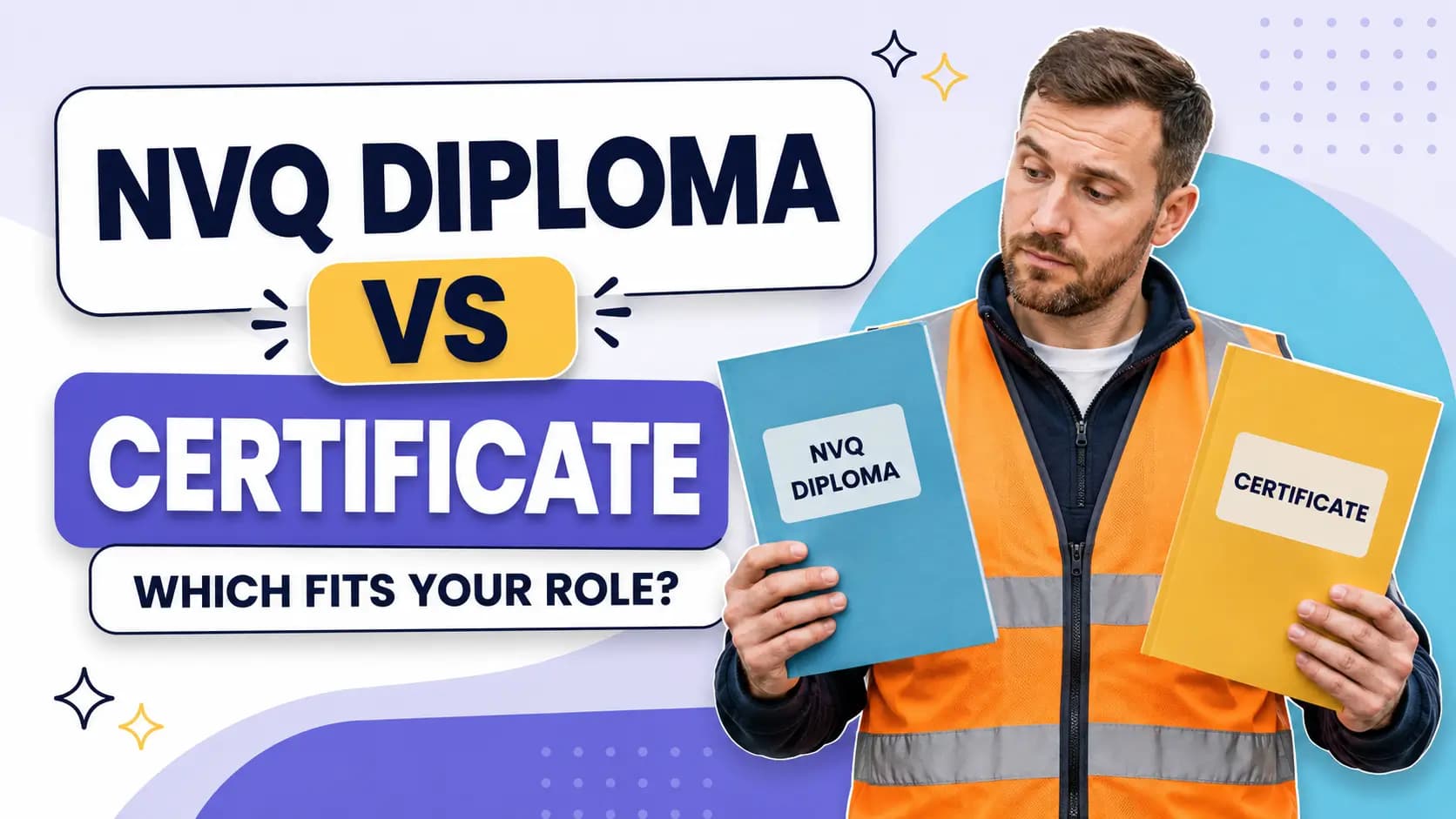
Choosing between an NVQ Diploma and an NVQ Certificate can be confusing, particularly when both qualifications are available at the same level.
A Diploma is usually larger and covers a broader occupational scope, while a Certificate generally focuses on a more defined set of workplace activities. However, a Diploma is not automatically at a higher level or more valuable than a Certificate.
The right choice depends on your actual job responsibilities, the units you can demonstrate in the workplace and any requirements set by your employer or industry card scheme.
Understanding the Main Difference
The terms Certificate and Diploma indicate the size of a qualification. The numbered NVQ level indicates the difficulty and complexity of the competence being assessed.
Ofqual normally uses:
Certificate for a medium-sized qualification
Diploma for a larger qualification
Qualification size is determined using Total Qualification Time, which estimates the overall time required for learning, preparation and assessment. It is not a guaranteed completion period. Ofqual qualification-design guidance
What Is an NVQ Certificate?
An NVQ Certificate confirms competence across a defined set of occupational activities. It may relate to a focused trade, technical activity or specialist workplace function.
A Certificate can be the complete qualification for an occupation. It should not automatically be regarded as an incomplete version of a Diploma.
It may be suitable if:
Your work covers a clearly defined occupational activity.
Your role has an officially recognised Certificate pathway.
You can demonstrate all required units in the workplace.
Your employer requires that specific Certificate.
The qualification supports your intended job or industry requirement.
What Is an NVQ Diploma?
An NVQ Diploma is a larger qualification that normally covers a wider range of occupational competence.
Depending on the occupation, it may include more technical activities, optional units, workplace responsibilities or supervisory functions.
It may be suitable if:
You regularly perform several connected occupational activities.
Your position involves wider technical responsibilities.
You plan or coordinate workplace operations.
You supervise workers, resources or work activities.
Your intended occupation specifically requires a Diploma.
You can provide evidence across its broader unit structure.
Qualification Size and Qualification Level
Certificate and Diploma describe how much content or assessment a qualification contains. They do not independently indicate how advanced it is.
Government guidance confirms that the qualification level represents difficulty. Higher levels require the demonstration of increasingly complex knowledge, skills, responsibility and autonomy. GOV.UK qualification-level guidance
Why the NVQ Level Matters
A Level 3 Certificate operates at a higher level of difficulty than a Level 2 Diploma, even though the Diploma is the larger qualification.
Similarly:
A Level 2 Certificate and Level 2 Diploma are at the same difficulty level but differ in size or occupational coverage.
Two Diplomas at the same level may assess completely different occupations.
A larger qualification is not necessarily more suitable for your job.
Employers may require an exact occupational pathway rather than any qualification at a particular level.
The complete qualification title should always be checked, including its level, occupational area and any pathway or endorsement.
Why the Occupational Pathway Matters
NVQs are designed around workplace competence. Different occupational pathways may lead to different qualification types, even within the same industry.
For example, one interior-systems pathway may lead to a Certificate because it covers a focused installation activity. Another pathway may lead to a Diploma because it requires competence across a broader range of installation tasks.
The difference reflects the scope of the occupation—not the importance or professional value of the worker.
Choosing the Right Pathway for Your Role
Your qualification should closely match the work you currently perform or the position for which you are actively developing competence.
A job title alone may not provide enough information. Two workers with the same title can have very different responsibilities depending on their employer, project and level of authority.
When a Certificate May Be the Better Choice
Consider an NVQ Certificate when:
Your work is limited to a recognised specialist activity.
The Certificate is the full qualification for your occupation.
Its mandatory units accurately reflect your daily duties.
You do not perform the broader activities required by the Diploma.
It satisfies the relevant employer or industry requirement.
Choosing a Certificate can be the correct professional decision when it accurately represents your competence.
When a Diploma May Be the Better Choice
Consider an NVQ Diploma when:
Your role covers a wider range of occupational activities.
You perform technical work across several competence areas.
Your position includes planning or coordination.
You supervise people, resources or workplace operations.
The Diploma is required for your intended progression route.
You have access to all workplace activities needed for assessment.
A Diploma should not be selected simply because it sounds more advanced. You must be able to demonstrate the required competence through valid workplace evidence.
Questions to Ask Before Enrolling
Before choosing a qualification, ask:
What tasks do I regularly perform at work?
Which qualification units match those tasks?
Can an assessor observe me completing the required activities?
Can I produce valid evidence for every mandatory unit?
Does my employer require a specific qualification?
Is the qualification accepted for my intended career or card route?
Is the qualification currently regulated?
You can verify regulated qualifications and compare recognised versions through the Ofqual Register of Regulated Qualifications.
How NVQ Assessment Works
Both NVQ Certificates and Diplomas are competence-based qualifications. Assessment focuses on whether you can perform the required activities to the specified occupational standard.
Official CSCS guidance explains that NVQs assess competence against National Occupational Standards. Candidates normally build a portfolio while an assessor observes their work, asks questions and signs off individual units once competence has been demonstrated. Official CSCS qualification guidance
Common Types of Evidence
Assessment evidence may include:
Direct workplace observation
Completed work products
Witness testimony
Professional discussion
Oral or written questions
Photographs and supporting documents
Workplace plans, reports and records
Relevant evidence from previous work
The assessment methods are broadly similar for Certificates and Diplomas. A Diploma will normally require evidence across a larger or broader group of units.
Workplace Access Requirements
Candidates must usually have access to real workplace activities that match the qualification requirements.
An NVQ is not normally completed through written assignments alone. Your assessor may need to observe you performing specific tasks and confirm that your work meets the required standard.
Simulation may be restricted or permitted only in particular circumstances. Before enrolling, confirm that your current job or placement provides access to all required activities.
How Long Does Completion Take?
A Diploma normally involves a greater volume of assessment than a Certificate. However, the actual completion time depends on:
Your occupational experience
The qualification’s unit structure
Access to suitable workplace activities
The quality of your existing evidence
How frequently the required tasks occur
Assessor availability
Any additional training you require
Candidates should be cautious of guaranteed completion periods. The qualification can only be awarded after all required competence has been demonstrated.
NVQ Certificates, Diplomas and CSCS Cards
Construction workers may need an accepted vocational qualification to obtain or renew a CSCS or CSCS-logoed card. However, neither a Certificate nor a Diploma automatically guarantees eligibility.
What Determines CSCS Eligibility?
Eligibility depends on:
The exact qualification title
The qualification level
The occupational pathway
The occupation shown on the card
The card category
The relevant health, safety and environment test
CSCS states that relevant construction NVQs at Level 2 may support the Blue Skilled Worker card. Level 3 NVQs may support appropriate Gold cards, while construction-management NVQs at Levels 5, 6 or 7 may support the Black Manager card. The exact qualification must still be accepted for the occupation. Official CSCS qualifications information
Checking Before You Enrol
Applicants for a Blue Skilled Worker card normally require an accepted construction-related Level 2 NVQ or SVQ and the relevant CITB Health, Safety and Environment test passed within the previous two years. CSCS Blue Skilled Worker card requirements
Use the official CSCS Card Finder to confirm:
The occupation you should select
The qualification required
The appropriate qualification level
The relevant test
The card available after completion
Do not rely solely on a general statement that a qualification is “CSCS approved.” Eligibility relates to the exact qualification and occupation.
Career Value and Progression
The professional value of an NVQ depends more on its relevance than its size.
Which Qualification Do Employers Prefer?
Employers generally prefer the qualification that matches the occupational role.
A specialist Certificate may be more appropriate for a defined technical position, while a Diploma may be preferred for a broader trade, supervisory or management role.
A Diploma will not necessarily improve your employment prospects if:
It relates to the wrong occupation.
Its units do not match the intended role.
A different qualification is required by the employer.
It does not support the necessary industry card.
Can a Certificate Lead to a Diploma?
In some cases, units completed within a Certificate may contribute towards a related Diploma. This is not automatic and depends on:
Whether the qualifications share compatible units
The current qualification specification
The validity of previous evidence
Recognition of prior learning rules
Awarding-organisation requirements
The selected occupational pathway
Sometimes a Certificate and Diploma represent different occupations rather than two stages of the same pathway. In that situation, additional units and new workplace evidence may be required.
Final Decision
Choose an NVQ Certificate when it is the recognised qualification for your specialist activity and accurately reflects the work you perform.
Choose an NVQ Diploma when your occupation involves broader technical, supervisory or management responsibilities and you can demonstrate competence across the larger unit structure.
The Diploma is normally the larger qualification, but it is not automatically the higher or better option. The correct pathway is the qualification that matches:
Your actual workplace responsibilities
The required level of competence
The relevant occupational pathway
Employer expectations
Career progression requirements
CSCS eligibility where applicable
Before enrolling, review the units, verify the qualification’s regulatory status and confirm any industry card requirements.
Frequently Asked Questions
Not automatically. Certificate and Diploma indicate qualification size, while the numbered level indicates difficulty. A Level 3 Certificate is therefore at a higher level than a Level 2 Diploma.
Not necessarily. A Certificate may be the complete qualification for a particular occupational pathway. Some Certificate units may contribute towards a related Diploma, but this must be verified against the current qualification structure.
A Diploma normally requires evidence across a larger or broader group of units. Completion time still depends on the candidate’s experience, workplace access, evidence and assessment arrangements.
Potentially. The exact qualification must be accepted for the relevant occupation and card category. The word Certificate or Diploma alone does not determine CSCS eligibility.
You need access to suitable workplace activities that allow you to demonstrate the required competence. This may be through employment or another acceptable workplace arrangement.
The most valuable qualification is the one that accurately matches your occupation and progression goals. A larger but unrelated Diploma may be less useful than a Certificate specifically required for your role.
Categories :