








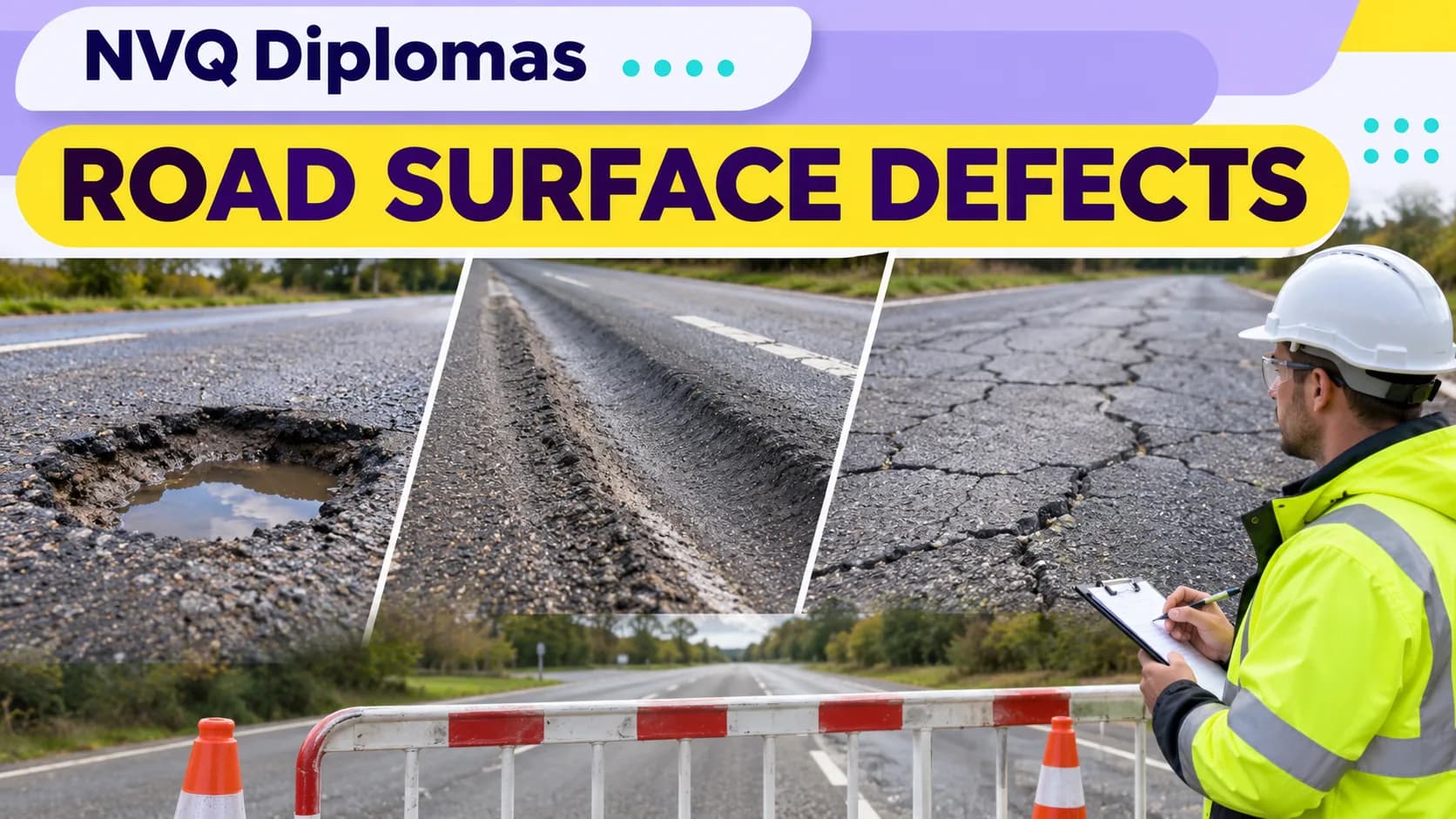
Road Surfacing Defects: Why Potholes, Rutting and Cracking Develop
Potholes, rutting and cracking describe different forms of road-surface distress. They can arise from interacting effects of traffic, water, temperature, materials and underlying support. The visible shape helps describe the defect, but does not by itself prove the cause or identify the correct repair depth. Treat immediate safety and longer-term diagnosis as separate decisions.
This guide helps learners, maintenance coordinators and asset owners make useful observations. It does not set a highway authority’s intervention threshold or instruct readers to enter live traffic to measure a defect.
Use descriptions that another inspector can repeat
A pothole is a local loss of pavement material forming a cavity. Rutting is longitudinal depression associated with wheel paths. Cracking may be longitudinal, transverse or interconnected; its location and pattern matter. Record the surface type and surrounding condition before applying a label.
The FHWA’s May 2014 distress-identification manual supplies a systematic vocabulary for asphalt pavement distress. It is an archived US research manual, not a current UK repair specification. Its purpose here is consistent description, not importing its severity categories into a local authority’s response policy.
Why these defects may develop
Pavement carries repeated loads through a layered structure. Material loss, deformation and cracks can reflect different weaknesses within that structure. Water can enter through defects and affect support, while repeated loading can enlarge already weakened areas. Temperature changes can also contribute to cracking. More than one mechanism may be present at a single location.
FHWA’s geotechnical pavement reference distinguishes load-associated fatigue cracking and rutting mechanisms. Use those principles to frame investigation questions, not to claim that every wheel-track depression has the same cause. Surface deformation and deeper settlement may require different evidence and repairs.
| Check | Question to resolve | Record |
|---|---|---|
Local cavity | Is material being lost, and is adjacent pavement also breaking down? | Location, extent, surrounding cracking and previous repairs. |
Wheel-track depression | Is it a repeated pattern or localised settlement? | Affected lane, length and relationship to traffic paths. |
Interconnected cracking | Is it concentrated in wheel paths or another area? | Pattern map and evidence of material loss or movement. |
Crack beside a reinstatement | How does it relate to the trench or patch boundary? | Reinstatement location and available work history. |
Standing water | Is drainage contributing or merely revealing a depression? | Weather, drainage condition and when water persists. |
Separate urgent reporting from investigation
A potentially dangerous defect should be reported promptly through the road owner’s emergency or defect-reporting route. Do not delay reporting while trying to establish its engineering cause. Give the location precisely and explain the risk to road users, including cyclists and motorcyclists, without entering the carriageway.
Response priority depends on the authority’s policy, road context and assessed risk. A single depth quoted online is not a universal legal definition of a pothole or a promise of a particular repair time. Likewise, a photographic scale can support an observation only when it can be placed safely under an authorised traffic-management arrangement.
Build a useful defect record
Capture the road or asset reference, direction, lane or edge position, nearby fixed landmark, observation date and whether the surface was wet. Add photographs from a safe place and describe associated cracking, loose material, drainage or deformation. Record whether a previous patch is failing, but do not assume that the last repairer caused the underlying defect.
The Department for Transport’s road-condition guide explains survey measures such as rut depth and cracking and notes that SCANNER surveys do not identify potholes as a specific defect. Network-level condition data and an individual safety inspection therefore answer different questions. A favourable network score does not establish that a particular location is safe.
Choose a repair that addresses the verified problem
A competent pavement assessment should consider whether distress is confined to the surface or extends deeper, how water is managed, and what surrounding material can provide a durable interface. Temporary measures may make a location safer while a fuller repair is planned. Record their purpose rather than describing them as a permanent solution by default.
Illustrative example: a patch repeatedly fails near a blocked drainage feature. The next enquiry should document the drainage, patch boundary and adjacent pavement condition, rather than merely ordering another bag of material. The eventual solution may involve several actions, but the observations alone do not establish which layer needs replacement. This is a hypothetical investigation brief.
Inspection and repair safety
Live traffic is a primary hazard. Inspection access, signing, lighting and guarding must be planned by the responsible team. The 2013 street-works and road-works code has defined applicability and excludes motorways and dual carriageways at 50 mph or more. Do not transfer a layout from it to an excluded road or devise an informal closure from this article.
Repair can add hot-material burns, moving plant, dust, noise, vibration and manual-handling risks. Use competent crews and the selected material’s instructions and SDS; this guide selects no repair product or operating temperature. Suspect older surfacing may need investigation before milling or disposal. Keep observation separate from intrusive sampling unless that work is authorised and controlled.
Maintain a record of the action, accepted repair specification and follow-up findings. The inspection and test plan guide helps organise acceptance evidence. Learners can explore the roadbuilding and maintenance qualification for practical competence development.
Scope and editorial method
This source-based guide was prepared with substantial AI assistance in research organisation and drafting. Primary references were checked on 20 November 2026. No independent technical review, named human contribution or firsthand project evidence has been verified. The featured image is AI-generated and illustrative. Examples are hypothetical. Use competent project-specific advice; this guide does not authorise design changes or hazardous work. HSE references concern Great Britain. Waste-law requirements described below concern England unless otherwise stated.
Frequently Asked Questions
No. Pattern, location, pavement construction and investigation evidence matter. Appearance alone cannot establish the repair.
No. Use the road owner’s intervention policy and risk assessment rather than a figure copied from another authority.
A repair needs to address the verified mechanism. Surface material alone may not correct deeper support or drainage problems.
No. Report from a safe location and leave carriageway inspection to teams with appropriate access and traffic controls.