








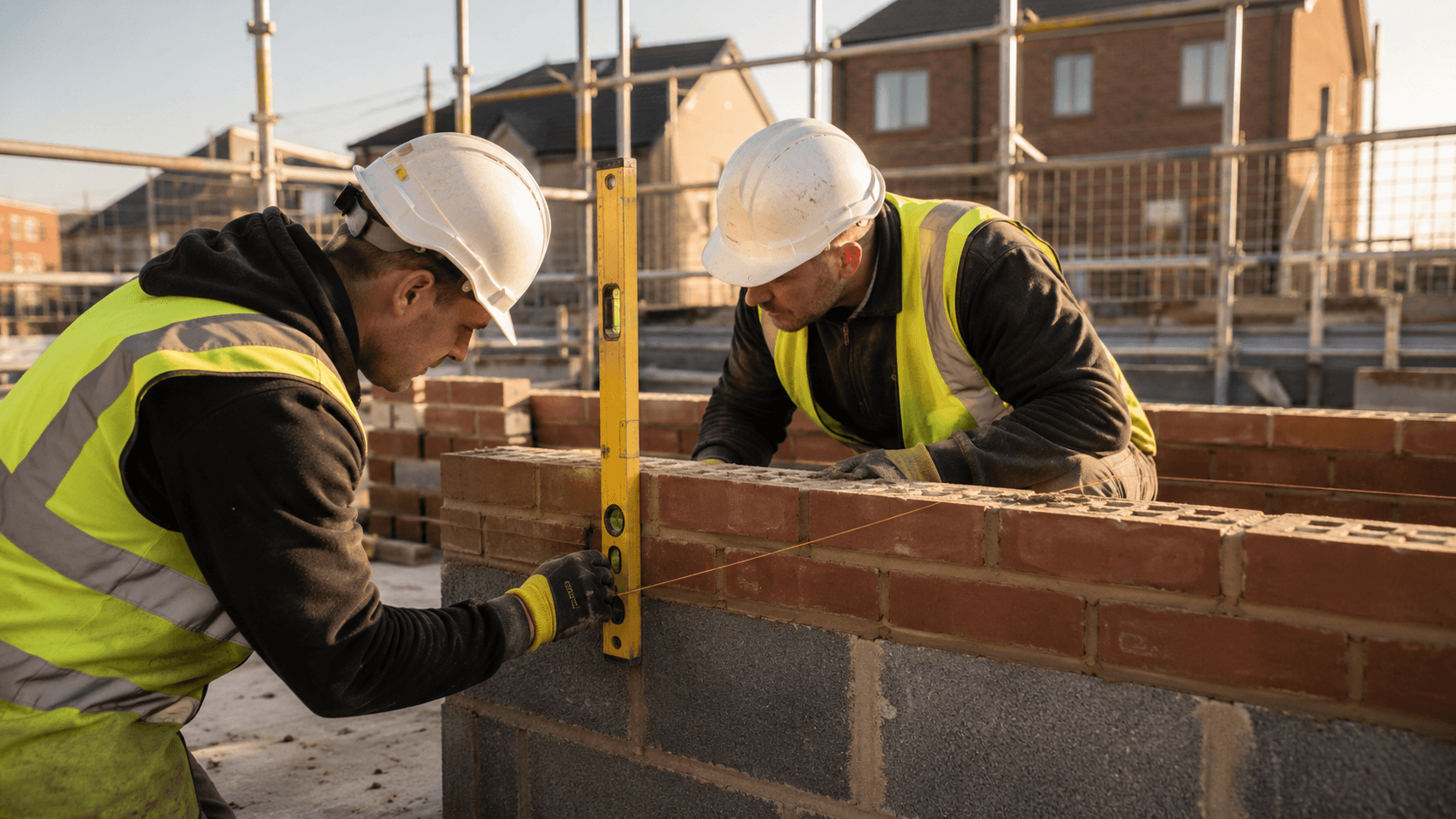
Level 2 NVQ Diploma for Brickwork Technicians
A work-based qualification for technicians who set out masonry and install specialist brickwork support and cavity components.
Overview
The Level 2 NVQ Diploma for Brickwork Technicians confirms occupational competence in the technical support activities required within brickwork and masonry construction. It is designed for workers who operate alongside bricklayers and undertake defined responsibilities for setting out masonry structures, using low-level access equipment and installing specialist masonry support, cavity and fire-protection components.
This is not a general labouring qualification or a complete bricklaying craft qualification. Its distinctive focus is the technician’s role in preparing accurate lines and levels and integrating components such as masonry support angles, fire barriers or fire breaks, brick soffit systems, wind posts, cavity trays, wall ties, insulation and wall starter systems.
Practical competence includes interpreting drawings and specifications, establishing dimensions and positions, selecting suitable resources, using hand and power tools, protecting cavities and installing specialist components to the required quality. Learners must also demonstrate safe working, productive cooperation, material handling and the correct use of access equipment up to six metres.
The qualification is assessed through evidence generated from genuine construction work. It allows experienced support workers to have their occupational competence formally recognised and helps employers demonstrate that technicians performing safety- and quality-critical masonry activities have been assessed against defined standards.
Current approved versions use slightly different title wording, including singular and plural references to the brickwork technician occupation. Their published structures nevertheless share the same six mandatory competence areas. Unit registration details and some wording may differ, but there is no general optional-unit pathway.
Qualification structures, unit wording and assessment requirements may vary slightly depending on the approved awarding organisation.
Who It’s For
This qualification is intended primarily for people already working in brickwork or masonry teams who undertake more technically defined duties than general site labouring but are not being assessed against the complete occupational scope of a bricklayer.
It may be suitable for:
Brickwork technicians working alongside bricklayers and masonry contractors
Experienced brickwork labourers progressing into a defined technical support role
Workers responsible for establishing masonry lines, levels, angles, curves or openings
Operatives installing masonry support angles and associated cavity components
Technicians involved with fire barriers, fire breaks, damp-proof systems, insulation or wind posts within masonry construction
Workers who erect, use and remove permitted access equipment for their own masonry-related tasks
Newer entrants who have sufficient supervised access to real brickwork activities and can build valid workplace evidence
Learners normally work under site procedures, drawings, specifications, method statements and risk assessments. They are expected to organise their own activities, select and check resources, recognise work outside their authority and communicate effectively with bricklayers, supervisors and other trades.
Employment, self-employment or another genuine workplace arrangement is normally necessary. Whatever the arrangement, the learner must have reliable access to live construction work where the full practical requirements and relevant endorsements can be demonstrated.
Occupational Endorsements
The qualification does not contain separate occupational pathways, and all six units are mandatory. However, two practical units require endorsements showing the particular equipment and specialist masonry activities demonstrated during assessment. The available combinations should be agreed with the assessment centre after reviewing the learner’s actual work.
Access Equipment Endorsements
The access-equipment unit normally requires evidence across at least two relevant equipment types. These may include:
Ladders
Stepladders or platform steps
Proprietary towers
Podiums
Mobile scaffold towers
The learner must have authorised access to the selected equipment and be permitted to erect, position, secure, check, use, remove and store it within the limits of the unit. An endorsement does not replace any separate training, inspection responsibility or site authorisation required by legislation, the employer or the equipment manufacturer.
Specialist Masonry Endorsements
The specialist masonry unit requires work involving fire barriers or fire breaks together with masonry support angles. The evidence must normally distinguish whether the learner installs or forms the relevant barrier or break.
Evidence is also required for at least two additional specialist masonry systems selected from:
Brick soffit systems
Channel systems
Wind posts
Vapour or moisture barriers
Wall starter kits
These are endorsements within a mandatory unit rather than optional qualification pathways. The final combination depends on the work available and the structure approved for delivery.
Workplace Requirements
Learners need sustained access to real brickwork or masonry projects where setting out and specialist component installation form part of their normal authorised duties. Occasional observation of another worker or training-centre practice alone cannot establish occupational competence.
Suitable work may take place on new-build housing, commercial developments, public buildings or other projects using masonry façades, cavities and associated support systems. The site must provide opportunities to interpret genuine contract information and work to project-specific dimensions, details and installation requirements.
Depending on the endorsements selected, access will normally be required to:
Construction drawings, specifications, schedules and installation details
Risk assessments, method statements and manufacturers’ instructions
Datum points, established survey information and site control lines
Levels, straightedges, laser levels, tapes, squares, lines, pegs, profiles, templates and trammels
Appropriate hand tools, portable power tools and ancillary equipment
Approved access equipment operating within the unit’s height limit
Masonry support angles and their specified fixings
Fire barriers or fire breaks used within masonry construction
Wall ties, insulation, cavity trays, damp-proof barriers, cloak systems, vents and weep-hole components
The specialist masonry systems selected for endorsement
Safe storage, lifting aids and facilities for handling fragile, loose, bagged or component materials
The learner must be able to complete the work personally while being observed or otherwise evidenced. Work must fall within the learner’s authority, competence and site permissions. Activities requiring design decisions, specialist certification or responsibilities held by another competent person must remain under the appropriate control.
Learning Outcomes
Successful learners can:
Follow site inductions, risk controls, method statements and safe systems of work
Recognise changing hazards and report unsafe conditions, unsuitable resources or incorrect information
Communicate with supervisors, bricklayers, customers and other occupations to coordinate productive work
Interpret drawings, specifications, schedules, sketches, manufacturers’ information and written or oral instructions
Plan work sequences and select appropriate materials, components, fixings, tools and equipment
Move, handle, position, secure and store masonry resources without avoidable injury, damage or contamination
Erect, check, use, remove and store endorsed access equipment up to six metres
Establish masonry dimensions, positions, lines, levels, depths, heights, angles, curves and openings
Create and use profiles, templates and trammels and transfer lines and levels accurately
Position, level, plumb, adjust and fix specialist masonry support and cavity components
Protect the continuity and integrity of cavities, insulation, damp-proofing and fire-resisting components
Check work against installation information, maintain records and report defects or circumstances outside their authority
Units
The qualification contains six mandatory units, all of which must be achieved. There are no generally available optional units. The access-equipment and specialist masonry units require evidence against defined endorsements, but those endorsements do not alter the mandatory unit structure.
- Follow site inductions, briefings, safety notices and authorised working procedures
- Use collective protection, personal protective equipment, respiratory protection and local exhaust ventilation when required
- Comply with risk assessments, method statements and relevant control measures
- Recognise hazards involving materials, substances, equipment, services, obstructions and changing site conditions
- Report hazards, incidents and unsafe circumstances through the correct organisational procedures
- Respond appropriately to fire, evacuation, accidents and other emergencies within personal authority
- Maintain welfare facilities and safely store protective equipment
- Dispose of waste and consumable materials in accordance with site and environmental requirements
- Stop work when there is serious or imminent danger
- Support site security arrangements and prevent unauthorised access to work areas and resources
- Communicate appropriately with supervisors, colleagues, customers and other trades
- Interpret organisational procedures when planning the sequence of work
- Coordinate setting-out and component-installation activities with the wider masonry programme
- Select and organise resources so that work can proceed efficiently
- Recognise how poor coordination may affect bricklayers, follow-on trades and construction progress
- Work to the agreed specification and report delays or resource problems promptly
- Complete relevant job records, worksheets, resource lists or timesheets clearly and within required timescales
- Maintain respectful working relationships and apply equality and diversity principles
- Reduce unnecessary material use, waste and carbon impacts where practicable
- Contribute to productive, low-waste working practices within the built environment
- Interpret information governing the movement, handling and storage of occupational resources
- Check instructions for lifting aids, mechanical assistance and designated storage locations
- Select resources of the correct type, quantity, quality and size
- Identify damaged, contaminated or unsuitable materials and report them
- Use safe manual-handling techniques and appropriate lifting aids
- Move, position, store and secure relevant materials, components, tools and equipment
- Demonstrate handling across the required range of loose, bagged, fragile, wrapped, liquid or component resources
- Prevent damage to masonry components, fixings, insulation and adjacent completed work
- Maintain stable, organised storage that does not obstruct access or create unnecessary risk
- Separate and dispose of packaging and waste in accordance with environmental and site procedures
- Complete handling activities within the allocated programme
- Consider the access and resource needs of bricklayers and other occupations
- Interpret plans, specifications, risk assessments, method statements and manufacturers’ instructions
- Select suitable access equipment for the location, task, loading and working height
- Check that equipment, components and the proposed base are suitable before use
- Establish protected work areas using barriers, screens or warning notices where required
- Move, position, erect and secure the endorsed access equipment
- Conduct pre-use and in-use checks and respond to defects or changing conditions
- Use ladders, steps, podiums or towers only for suitable and authorised activities
- Use and maintain the associated hand tools and ancillary equipment
- Work safely around other workers, vehicles, plant and machinery
- Remove, clean and store access equipment without damaging it or the surrounding work
- Report circumstances requiring specialist access knowledge or authority
- Demonstrate the minimum required range of equipment endorsements
- Extract dimensions, locations and construction requirements from drawings, specifications, schedules and electronic information
- Confirm instructions derived from risk assessments and method statements
- Identify datum points and verify that the available setting-out information is suitable
- Select and check levels, lines, profiles, templates, trammels, tapes, squares, pegs and fixings
- Calculate distances, quantities, lengths, levels, diagonals, areas and appropriate material allowances
- Measure and mark out on level or sloping ground
- Establish straight lines, right angles and other specified angles
- Set out curves in plan or elevation and define openings
- Make and position profiles, templates and trammels
- Transfer lines and levels using appropriate manual or laser equipment
- Determine concave or convex curves using pegs and lines where required
- Plumb from ranging lines and secure setting-out controls against accidental movement
- Protect established marks, profiles and adjacent work from damage and adverse weather
- Check completed setting out against the working information and installation quality requirements
- Communicate established controls clearly to the brickwork team
- Report discrepancies, unsuitable information or work requiring specialist setting-out competence
- Interpret detailed drawings, specifications, schedules, installation instructions and building requirements
- Select suitable support elements, barriers, fixings, tools and equipment
- Check component type, dimensions, condition, compatibility and specified location
- Position, level, plumb, adjust and secure masonry support angles
- Install or form the endorsed fire barriers or fire breaks while maintaining their required continuity
- Install the required additional specialist masonry systems for the selected endorsements
- Position and integrate brick soffit systems where included in the learner’s evidence
- Install channel systems, wind posts or wall starter kits where selected
- Form and preserve cavity dimensions and prevent mortar or debris from compromising the cavity
- Position wall ties at the specified spacing, including around openings
- Install cavity trays, damp-proof barriers and cloak systems to the required arrangement
- Form weep holes and vents in their specified locations
- Position, bond and tape insulation while maintaining continuity
- Maintain the integrity of vapour or moisture barriers where applicable
- Use appropriate hand tools, power tools, access equipment and fixing systems
- Inspect installation quality and report defective, incompatible or incorrectly specified components
- Protect completed elements from damage and adverse weather
- Dispose of waste safely and complete the work within the agreed programme
- Recognise when design clarification or specialist competence is required and refer the matter appropriately
Assessment
Assessment establishes whether the learner can perform the complete brickwork technician role described by the units, not simply explain how the work should be done. A portfolio must demonstrate achievement of every learning outcome, assessment criterion and required endorsement.
Workplace Observation
A competent assessor normally observes the learner carrying out representative tasks on live construction projects. Observation may include establishing masonry lines and levels, using endorsed access equipment, installing support angles and integrating fire, moisture-control or cavity components.
Assessment should show that the learner can:
Prepare and sequence the activity
Interpret the relevant project information
Select and inspect resources
Apply the required safety controls
Complete the technical task to specification
Check the result and respond to defects
Coordinate with the brickwork team and other occupations
Protect the work and leave the area safe
Evidence should demonstrate reliable performance under normal workplace conditions rather than a single isolated task.
Portfolio and Work Products
The portfolio brings together evidence from the learner’s actual work. Suitable evidence may include:
Assessor observation records
Authenticated photographs or video showing the learner completing practical tasks
Marked-up drawings, setting-out sketches or dimensional checks
Records of established lines, levels, profiles, curves or openings
Installation checklists for support angles, barriers, wall ties or cavity components
Manufacturers’ instructions used during the work
Risk assessments and method statements linked to observed activities
Material or component records
Work sheets, job cards and relevant progress records
Evidence showing the endorsed access equipment and specialist masonry systems
Learner accounts explaining decisions, problems and corrective action
Photographs or documents must be attributable to the learner and placed in context. Images of completed work alone may not prove who performed the activity or how competence was applied.
Professional Discussion and Questioning
Professional discussion and oral or written questioning are used to confirm knowledge that cannot always be observed directly. Questions may address:
Interpretation of masonry drawings, dimensions and specifications
Setting-out calculations and methods
Component compatibility, common defects and reporting procedures
Fire-barrier and cavity-integrity requirements
Safe access-equipment selection and inspection
Manual handling and material storage
Protection of work from damage or weather
Environmental responsibilities and waste control
Emergency procedures and the limits of the learner’s authority
Knowledge evidence supports practical assessment but does not replace the requirement to perform occupational tasks.
Witness Testimony and Prior Experience
Testimony from a suitably experienced person may support evidence of workplace performance where direct assessor observation is impracticable. The assessor remains responsible for judging whether the testimony is authentic, current and sufficient.
Recognition of Prior Learning may allow existing knowledge or earlier workplace evidence to contribute where it can be mapped reliably to current requirements. Previous experience does not result in automatic achievement; every mandatory unit and endorsement must still be evidenced.
Restrictions on Simulation
Practical competence must be demonstrated in a real working environment. Simulated setting out, access-equipment use or specialist masonry installation cannot replace evidence of workplace performance.
Training and controlled practice may help a learner prepare, but they do not by themselves prove occupational competence. To complete the qualification, the learner must achieve every mandatory unit and all required endorsements through valid, authentic and sufficient evidence.
Career Progression
The qualification recognises a defined technical role within masonry construction. Progression depends on the learner’s experience, the work undertaken and whether further qualifications are needed for the intended occupation.
Brickwork Technician Roles
Successful learners may continue or develop in roles involving:
Masonry setting-out support
Installation of masonry support systems
Cavity-component installation
Fire-barrier or fire-break work associated with masonry
Brick soffit, wind-post or wall-starter installation
Technical support within brickwork contracting teams
The qualification does not, by itself, confirm the full occupational competence of a bricklayer because it does not assess the complete range of bricklaying activities.
Progression into Bricklaying
Learners who move into laying bricks, blocks or other masonry across the full craft scope may progress to an appropriate bricklaying or trowel-occupations qualification. Further assessment would be required for activities such as preparing mortars, constructing masonry structures, forming joint finishes and completing the broader range expected of a competent bricklayer.
Advanced Craft and Supervision
With broader craft experience, learners may progress towards advanced masonry or trowel-occupation qualifications. Workers who later take genuine responsibility for coordinating people, resources, work quality and site activities may consider an occupational work-supervision qualification.
Progression to supervisory, inspection or management work is conditional on having the necessary experience and workplace authority. This Diploma does not automatically confer supervisory status or responsibility for design, fire-safety approval or specialist inspection.
FAQs
The following questions address the most important practical distinctions, evidence requirements and occupational limits associated with this qualification.
No. It is designed for brickwork technicians who support masonry construction through setting out and the installation of specialist masonry elements. It does not assess the complete range of bricklaying competence found in a full trowel-occupations or bricklaying qualification.
Yes. The practical skills must be assessed in a real working environment. You need access to genuine brickwork activities, project information, tools, components and suitable work opportunities covering all mandatory units and endorsements.
No general optional units are included in the current structures. All six units are mandatory. Variation occurs through the equipment and specialist masonry endorsements evidenced within two of those units.
You must have access to work involving masonry support angles and an endorsed form of fire barrier or fire break activity. You must also demonstrate the required range from brick soffit systems, channel systems, wind posts, vapour or moisture barriers and wall starter kits.
No. The access unit requires an approved minimum range rather than every listed type. The selected equipment must reflect your real work and may include ladders, steps, podiums or proprietary and mobile scaffold towers.
Training-centre practice may support preparation, but it cannot replace practical assessment in a real workplace. Evidence of occupational skills may not be simulated.
Relevant prior evidence may be considered if it is current, authentic and clearly demonstrates the required competence. The assessor must map it against the present units and endorsements, and additional observation or questioning may still be necessary.
No. It assesses the correct installation or formation of specified components within the learner’s occupational authority. It does not grant design authority, inspection status or responsibility for approving fire-safety systems where separate competence or appointment is required.
Application Form
Apply Now For This Course
An adviser will review your eligibility for Level 2 NVQ Diploma for Brickwork Technicians and reply within 1–2 working days.
Qualification Includes:
 Level2
 Lessons6
 CertificationYes
 Students1200
Related Diplomas
More qualifications in Construction Trades and Building Envelope that may suit a similar workplace role.
%25E2%2580%2594Mason.jpg&w=3840&q=75)
-5.jpg&w=3840&q=75)
.jpg&w=3840&q=75)
Featured Qualifications
Popular NVQ pathways learners often explore next.
.png&w=3840&q=75)
.png&w=3840&q=75)
