








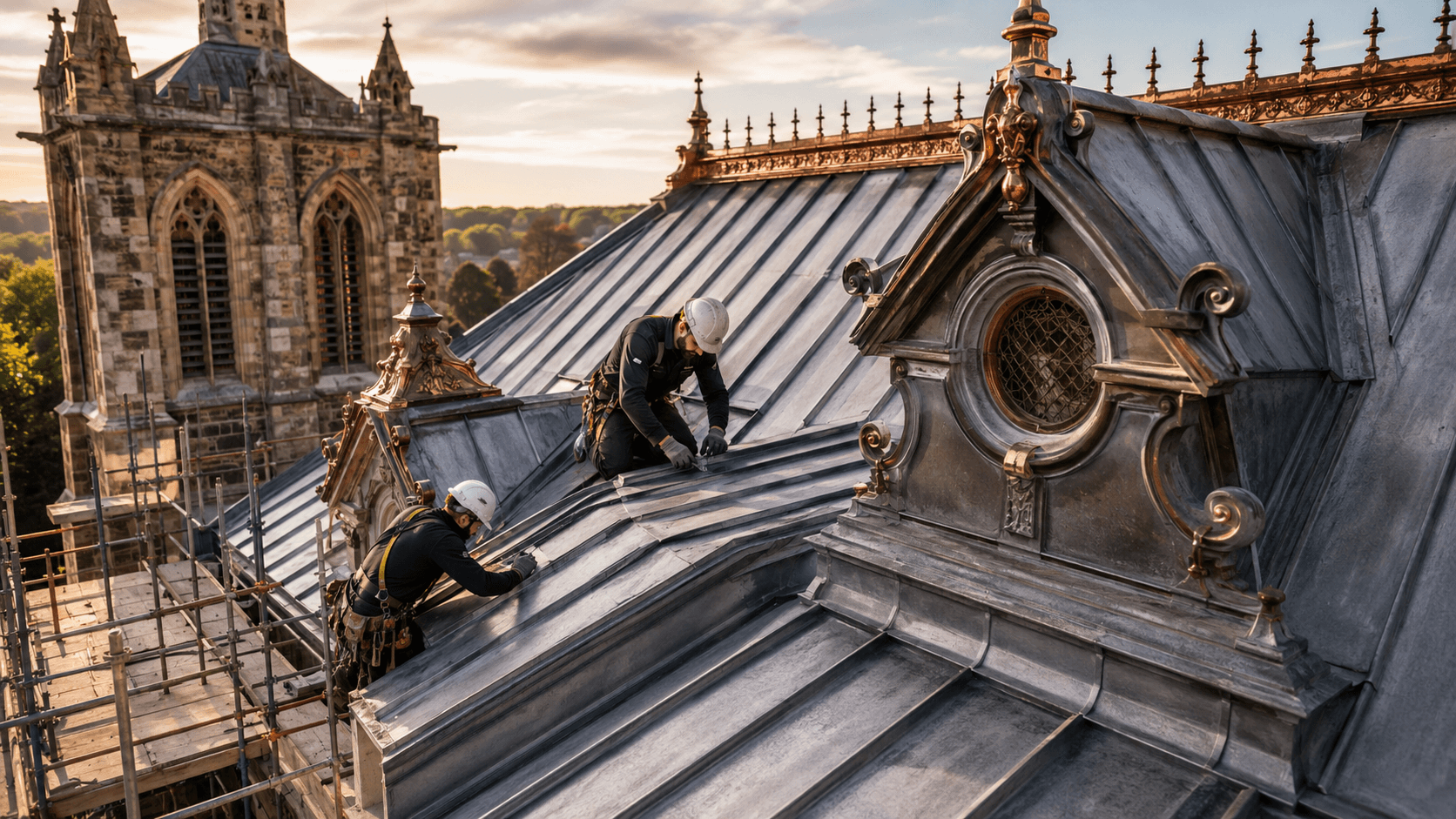
Level 3 NVQ Diploma in Heritage Skills—Fully Supported Lead and Hard Metal Roofing and Cladding
Proves workplace competence in heritage lead and hard metal roofing, cladding, weatherings, decorative work and conservation practice.
Overview
The Level 3 NVQ Diploma in Heritage Skills (Construction) – Fully Supported Lead and Hard Metal Roofing and Cladding is a work-based competence qualification for skilled operatives carrying out specialist metal roofing work on heritage, traditional and other appropriate buildings.
It is concerned with the installation, repair, maintenance and specialist fabrication of fully supported lead and hard metal roof coverings, cladding and weatherings. Its scope extends beyond routine metal roofing by requiring competence in conservation and restoration practice, decorative roof forms and the production of ornamental features.
The qualification confirms that a learner can interpret drawings, specifications, schedules, method statements and other occupational information; organise work and resources; select and use suitable materials and equipment; work safely at height; protect existing building fabric; and complete specialist metal roofing work to the required specification.
Practical competence includes activities such as preparing substrates, setting out joints, cutting and profiling sheet metal, fitting underlays where required, installing roofing and vertical cladding, forming weatherings, maintaining joint and fixing integrity, repairing defective coverings and producing more complex decorative or ornamental components.
Heritage work is an important part of the qualification. Learners must demonstrate that they can work in ways appropriate to buildings or structures of special interest, traditional construction and historic significance. This includes recognising sensitive areas, protecting existing fabric, applying conservation principles and reporting conditions or proposed work that require specialist advice.
Current regulated versions are available through more than one approved awarding organisation. The current structures compared are closely aligned and require the same nine occupational competence areas, with no separate optional-unit group for this pathway. Some specifications record occupational endorsements more explicitly than others, particularly for Lead and Hard Metals and for the conservation and restoration unit.
A recent update to one current qualification suite retained this particular heritage roofing pathway without structural change. Historical editions and older unit identifiers may still appear in records, but current registered specifications should always be used when determining assessment requirements.
For experienced workers, the Diploma provides formal recognition of competence across specialist heritage metal roofing activities. For employers, it provides structured evidence that an operative has been assessed against recognised occupational standards in genuine working conditions rather than solely through classroom or workshop activity.
Who It’s For
This qualification is intended primarily for experienced operatives whose normal work involves fully supported lead or hard metal roofing and cladding, particularly where the work includes traditional, historic, conservation or technically complex applications. It is not designed as a classroom-only introduction to roofing.
Typical occupational contexts include heritage roofing contractors, specialist leadwork businesses, hard metal roofing contractors, conservation contractors and roofing teams carrying out work on historic or traditionally constructed buildings.
Suitable learners may work as:
heritage lead roofing specialists;
heritage hard metal roofing specialists;
fully supported lead and hard metal roofers and cladders;
specialist leadworkers undertaking roof coverings, weatherings and decorative work;
metal roofing operatives working on conservation and restoration projects;
experienced craft operatives producing decorative or ornamental lead and hard metal features.
Learners are expected to have sufficient responsibility to organise their own work, interpret technical information, select resources, resolve routine occupational problems and communicate with supervisors, clients or other trades where necessary. They must also be able to recognise situations that exceed their own authority or technical competence and report them appropriately.
A genuine workplace role is essential because the qualification requires direct evidence of occupational competence. Some current specifications state explicitly that the learner must be employed, while the overarching requirement across current versions is that assessment takes place in a real work environment. A learner therefore needs an accepted workplace arrangement that provides authentic opportunities to complete the required specialist activities.
The work opportunities available must be sufficiently broad to generate evidence of installation, repair and maintenance, conservation or restoration, decorative roofing or cladding and ornamental metalwork. Access only to routine flashing work or isolated minor repairs would not normally provide the breadth of evidence required for the whole Diploma.
Endorsements and Occupational Specialism
The qualification is itself a specialist heritage pathway for fully supported lead and hard metal roofing and cladding. Within that pathway, current specifications may use endorsements to identify the particular material or occupational area in which competence has been demonstrated. Endorsements should not be confused with optional units: the current structures compared require all nine mandatory units.
Lead
Some current specifications require the specialist roofing units to carry a Lead or Hard Metals endorsement, according to the work used for assessment.
A Lead endorsement reflects occupational evidence involving lead sheet roofing, cladding, weatherings, decorative work or ornamental features. Depending on the particular unit, work may include:
preparing and setting out lead for fully supported roofing or cladding;
cutting, profiling, dressing and securing lead;
forming and maintaining joints and terminations;
installing lead weatherings to relevant building details;
repairing or replacing defective lead coverings;
forming decorative profiles;
producing ornamental lead components;
working safely where lead dust or fume could present an exposure risk.
The exact endorsement recorded must follow the current specification under which the learner is registered.
Hard Metals
The Hard Metals endorsement is used in some current specifications where the learner's evidence is based on fully supported hard metal roofing, cladding, weatherings, decorative work or ornamental production.
Occupational standards for this work recognise materials such as copper, zinc, aluminium, stainless steel and galvanised steel where appropriate to the job. This does not mean that every learner must work with every type of hard metal. The material used must match the specification, the building, the assessment requirements and the learner's actual occupational role.
Evidence can involve setting out, cutting, profiling, jointing, fixing and terminating hard metal coverings, together with work on roof, cladding and weathering details.
Conservation and Restoration Occupational Focus
The conservation and restoration competence area may also carry an occupational endorsement in some approved structures. Current specifications provide several heritage occupations from which the appropriate endorsement is selected.
For this Diploma, the evidence must be relevant to the learner's actual heritage metal roofing work, such as roofing or leadwork, rather than an unrelated heritage trade. The exact endorsement arrangement should therefore be confirmed against the learner's registered version before assessment begins.
Workplace Requirements
The Diploma depends on authentic occupational evidence. Learners need continuing access to real projects where they can carry out specialist metal roofing tasks under normal workplace pressures, restrictions and quality requirements.
The workplace should provide opportunities to work with appropriate combinations of:
fully supported lead or hard metal roof coverings;
pitched, low-pitched or other relevant fully supported roof areas;
vertical cladding;
horizontal, vertical and inclined weatherings;
soffits, cornices, parapets or gutters where required by the assessed unit;
existing roof or cladding requiring inspection, repair or maintenance;
traditional or historically significant building fabric;
decorative roof or cladding forms;
ornamental metal features;
underlays, ventilation components, fixings, fittings and ancillary materials;
hand tools, powered tools and specialist forming or fabrication equipment;
suitable access equipment and collective or personal work-at-height controls.
Projects must also provide sufficient technical information for the learner to demonstrate interpretation of drawings, specifications, schedules, method statements, risk assessments, manufacturers' information and other relevant instructions.
Heritage evidence needs to involve genuine conservation or restoration considerations. The learner may need to recognise sensitive building fabric, maintain historical or archaeological integrity, minimise unnecessary intervention, remove inappropriate or deteriorated material and repair, restore, reinstate or replace components in accordance with the project requirements.
Roofing work also exposes learners to significant health and safety risks. Evidence should show competent use of access arrangements and work-at-height controls, safe movement and storage of materials, correct use of tools and equipment and compliance with controls for occupational substances.
Lead work requires particular care. Work involving lead can create exposure through dust, fume or contamination, so the learner must follow the relevant risk assessment, method of work and workplace control measures. Where required by the work, this can involve collective controls, PPE, suitable respiratory protection and local exhaust ventilation.
The workplace must give the assessor a realistic opportunity to judge competent performance. Training rigs, workshop pieces and centre exercises may help develop skills, but the current unit assessment requirements state that workplace evidence of occupational skills cannot be simulated.
Learning Outcomes
Successful completion demonstrates that the learner can apply specialist heritage roofing knowledge and practical competence to genuine work activities. Depending on the registered endorsement and projects used for evidence, the learner will be able to:
interpret drawings, specifications, schedules, instructions, risk assessments, method statements and manufacturers' information relevant to specialist metal roofing;
identify work activities, determine required resources and plan a logical sequence of work;
obtain clarification where information or resources are incomplete, unsuitable or unavailable;
select work methods that make effective use of labour, materials, equipment and time while meeting technical, contractual and statutory requirements;
monitor progress and report circumstances requiring changes to the planned work;
communicate effectively with clients, supervisors, other crafts and relevant project personnel;
maintain safe working practices for roof work, access equipment, manual handling, tools, substances and other occupational hazards;
recognise and apply appropriate controls when working with lead and other materials that may create hazardous dust, fume or contamination;
select lead, hard metal, underlays, vents, fixings, fittings, ancillary materials, hand tools and powered equipment appropriate to the specified work;
calculate and control material quantities, dimensions and wastage relevant to the work;
prepare substrates and identify faults in supporting construction or interfaces that could affect the roofing or cladding work;
set out, cut, profile, position, join, fix, secure and terminate fully supported lead or hard metal roofing and cladding;
install or form appropriate weatherings and maintain the integrity of joints, fixings and ventilation arrangements;
inspect existing coverings and carry out appropriate repair and maintenance work;
fabricate decorative lead or hard metal roofing and cladding to complex profiles;
produce specified ornamental lead or hard metal features using appropriate forming and joining methods;
work sensitively on conservation and restoration projects, protecting significant existing fabric and applying recognised heritage principles;
protect completed and surrounding work, control waste and minimise unnecessary environmental impact;
identify occupational problems, defects or specialist requirements and report matters outside personal authority;
complete work to the required specification and within the agreed work programme.
Units
Current approved structures compared for this qualification require nine mandatory units. There is no separate optional-unit group for the fully supported lead and hard metal roofing and cladding pathway. Endorsements may, however, be applied to particular specialist units according to the learner's material and occupational evidence.
All mandatory competence areas described below must be achieved. The detailed wording and endorsement recording used by an individual approved version can vary, so assessment must follow the learner's current registered specification.
- comply with site inductions, briefings, risk assessments, method statements, safety notices and organisational procedures;
- use health and safety control equipment in accordance with instructions;
- understand the hierarchy and purpose of collective protective measures, PPE, RPE and local exhaust ventilation where relevant;
- recognise hazards that are not adequately controlled and report them to an authorised person;
- respond appropriately to emergencies, fire, evacuation and other workplace incidents within personal authority;
- use welfare facilities appropriately and maintain arrangements intended to protect health;
- understand how individual behaviour can affect the safety and wellbeing of other people;
- follow workplace security arrangements for personnel, equipment and resources;
- avoid undertaking activities for which the learner lacks the required competence or authorisation.
- identifying the work activities required from available project information;
- assessing the labour, materials, tools, access equipment and other resources needed;
- planning an effective sequence for personal work;
- recognising interfaces and dependencies between the roofing work and other occupations;
- obtaining advice when specified resources are unavailable and considering appropriate alternatives;
- evaluating different ways of using resources while maintaining quality, safety and project requirements;
- considering environmental and low-carbon implications when organising work and using resources;
- monitoring progress against the work programme;
- identifying changed circumstances that require an alteration to the planned sequence;
- communicating proposed programme changes and their likely effect to relevant decision-makers.
- communicate appropriately with people involved in the work;
- provide accurate information about progress, results, technical issues and health and safety requirements;
- offer relevant advice about methods of carrying out occupational work activities;
- encourage questions, comments and requests for clarification;
- discuss proposed activities and alternatives with relevant people;
- coordinate work where roofing activities affect or depend on other occupations;
- respond constructively to differing opinions;
- resolve routine disagreements while maintaining goodwill, trust and respect;
- work in ways that respect equality, diversity and the responsibilities of other people.
- assess available project information, including specifications, drawings, quantities, timescales and scope of work;
- interpret information to establish the required sequence, techniques and working conditions;
- obtain additional information from clients, suppliers, regulatory sources, manufacturers or other authorised sources when project data is insufficient;
- compare potential methods before deciding how the work should be carried out;
- select a method that uses people, materials and equipment effectively;
- incorporate health, safety, welfare, access, fire protection and pollution controls;
- consider waste management, environmental performance and relevant weather conditions;
- ensure the chosen method complies with technical, statutory, contractual and quality requirements;
- communicate the confirmed method to relevant people;
- identify changes or circumstances that make the planned method inappropriate and report them through the correct procedure.
- interpret drawings, specifications, conservation plans, method statements, schedules, historical information and other relevant project documentation;
- recognise the significance and sensitivity of the building, structure or fabric being worked on;
- identify situations where archaeological, conservation or specialist requirements affect the work;
- select suitable materials, components, fixings, tools and equipment for the approved conservation method;
- use access and health and safety equipment safely while protecting the historic fabric;
- measure, mark out, adapt, align, make good, maintain, conserve, restore, reinstate, finish, position or secure work as required;
- sample, select, prepare and match appropriate materials or components;
- retain heritage and archaeological integrity during work;
- apply principles such as minimum intervention and, where required by the project, reversible alteration;
- remove deteriorated or inappropriate material without causing avoidable damage;
- repair, restore or reinstate existing fabric or components;
- recognise work requiring specialist knowledge and obtain appropriate guidance;
- protect the work and surrounding area and control waste responsibly.
- interpret instructions, drawings, electronic information, specifications, schedules, method statements and risk assessments;
- select appropriate lead or hard metal, underlay, vents, fixings, fittings, ancillary materials, tools and equipment;
- understand the relevant characteristics, uses, limitations, quality requirements and potential defects of the selected resources;
- calculate required quantities, dimensions, areas and anticipated wastage;
- use work-at-height arrangements and access equipment safely;
- protect the work, surrounding fabric and adjacent occupations from damage;
- clean or clear the substrate and identify defects that could affect the installation;
- identify and report faults in the substructure or roof interfaces;
- install underlay where required;
- install or fabricate ventilation arrangements required by the work;
- set out joints and prepare sheet metal to the required length and profile;
- measure, set out, cut, profile, position, secure and join the selected metal;
- install fully supported flat lead roofing or appropriate low-pitched hard metal roofing;
- install fully supported pitched roof coverings and vertical cladding;
- form required weatherings to horizontal, vertical or inclined surfaces and abutments;
- demonstrate specified weathering work involving relevant details such as soffits, cornices, parapets or gutters;
- join and terminate the metal correctly in width and length;
- maintain the integrity of joints, fixings and ventilation;
- recognise requirements associated with traditional or historically significant structures;
- use and maintain hand tools, powered tools and ancillary equipment correctly;
- complete work to specification while maintaining a clean work area and disposing of waste appropriately.
- interpret information describing the required repair or maintenance work;
- establish safe access and appropriate controls before disturbing existing coverings;
- inspect surfaces and components to determine their condition;
- identify and report faults involving supporting construction or roof interfaces;
- select suitable lead or hard metal, underlays, fixings, finishing materials, ancillary items and tools;
- understand material characteristics, limitations, sustainability considerations and common defects relevant to the repair;
- measure, mark out, remove, cut, joint, fix or dress, position and secure materials;
- remove defective coverings or components where required;
- repair, reinstate or replace defective elements in accordance with the working instructions;
- install or repair fully supported lead or hard metal roofing, cladding and weatherings;
- maintain the integrity of joints, fixings and associated details;
- protect retained materials and surrounding building fabric during the repair;
- use and maintain hand tools, powered tools and ancillary equipment safely;
- manage removed material and other waste in accordance with workplace and environmental requirements;
- identify circumstances requiring specialist intervention and report them appropriately.
- interpret drawings, specifications, dimensions, patterns and other information for the ornamental work;
- select suitable metal, fixings, finishing items, tools and fabrication equipment;
- calculate material quantities and control waste;
- produce patterns or templates required for fabrication;
- measure, mark and set out the work accurately;
- use relevant craft processes such as casting, cutting, folding, stretching, reducing, pressing and bossing;
- use welding, soldering, jointing or other appropriate joining methods where required by the material and design;
- fit, finish, position and secure completed features;
- produce the required range of ornamental work, which may include scrolls or bullnoses, finials or bosses, hoppers or planters, ornaments, shingles or preformed panels;
- maintain the structural and weathering integrity of joints;
- protect finished surfaces and surrounding work from damage;
- recognise when a design or fabrication problem requires additional specialist knowledge;
- take account of the requirements of buildings of special interest, traditional construction or historical significance;
- use access equipment safely where the feature is produced or installed at height;
- maintain specialist hand tools, powered tools and ancillary equipment.
- interpret drawings, specifications, schedules, risk assessments and other technical information for the decorative work;
- select suitable lead or hard metal, underlay, vents, fixings, fittings, ancillary items and tools;
- assess material characteristics, quality, limitations and potential defects;
- calculate quantities, lengths, areas and wastage;
- identify and report unsuitable substrates, interfaces or resources before installation;
- set out and mark roof or cladding geometry accurately;
- measure, profile, cut, joint, position, secure and finish the metal;
- install decorative coverings or weatherings to the required shaped profiles;
- demonstrate work across the range specified by the current unit, which can include tapered, concave, convex and segmented profiles;
- work on forms such as spires, domes, cupolas, onion-shaped details or barrel-vault structures where required by the project;
- form coverings or weatherings to relevant soffits, cornices, parapets, gutters, surfaces and abutments;
- prepare and fabricate the metal to the required length and profile;
- install underlay and ventilation arrangements where required;
- join and terminate metal accurately in width and length;
- maintain the integrity of joints, fixings and ventilation;
- protect complex completed work from damage and adverse conditions;
- recognise situations where the historic nature or complexity of the structure requires specialist advice;
- complete the decorative work safely, to specification and within the agreed programme.
Assessment
Assessment is based on demonstrated occupational competence rather than attendance at a taught course. The learner must provide sufficient evidence to show achievement of the learning outcomes and assessment requirements for every mandatory unit in the current registered structure.
The qualification is assessed in a work environment in accordance with the applicable construction-sector assessment strategy. Specialist practical competence must therefore be demonstrated through authentic activities such as installing and repairing metal roof coverings, producing decorative profiles, fabricating ornamental features and carrying out conservation or restoration work.
Workplace Observation
Direct observation is a central source of evidence for practical competence. An occupationally competent assessor can observe the learner planning and carrying out work on genuine projects.
Relevant observations may include:
establishing safe access to a roof;
interpreting project information before starting work;
preparing a substrate or existing roof area;
setting out joints and details;
cutting, profiling and installing lead or hard metal;
forming weatherings;
repairing defective coverings;
producing decorative roofing or cladding;
fabricating ornamental features;
protecting historically significant fabric;
coordinating the work with other occupations.
Observation must show competent performance under realistic site conditions and against the requirements of the relevant unit.
Portfolio and Work Products
Each learner needs a portfolio or equivalent evidence record demonstrating achievement across the mandatory units.
Occupation-specific evidence can include:
photographs of roofing, cladding and weathering work at identifiable stages;
completed roof or cladding sections;
fabricated decorative or ornamental components;
drawings, patterns or templates used for specialist work;
relevant method statements or work instructions used by the learner;
inspection or condition information associated with repair work;
records showing material selection or quantities;
project records demonstrating conservation or restoration activity;
assessor observation records;
authenticated employer or site records;
suitable witness testimony from people with direct knowledge of the work.
Evidence must be attributable to the learner. Photographs or documents without sufficient context or authentication do not by themselves establish occupational competence.
Professional Discussion and Questioning
Practical observation cannot always reveal why a particular material, joint, control measure or conservation method was selected. Underpinning knowledge can therefore be confirmed through professional discussion and oral or written questioning.
Questioning may explore:
interpretation of drawings and specifications;
properties and limitations of lead and relevant hard metals;
methods of setting out, forming, jointing and fixing;
causes and implications of defects;
ventilation and underlay requirements;
work-at-height arrangements;
lead exposure and other health risks;
environmental responsibilities and waste control;
conservation principles and treatment of significant existing fabric;
circumstances requiring specialist advice;
communication, planning and programme responsibilities.
The assessment method must confirm that the learner personally understands the decisions and procedures demonstrated through workplace evidence.
Witness Evidence
Witness testimony can contribute where a competent person has directly observed relevant work that the assessor could not reasonably attend. It must describe what the learner actually did and be capable of authentication.
Witness evidence may be particularly useful for project activities that occur infrequently, but it does not remove the assessor's responsibility to judge whether the overall evidence is sufficient and meets the relevant assessment strategy.
Recognition of Prior Learning
Relevant previous learning or occupational evidence may be considered where it can be authenticated and mapped to the current requirements.
Recognition of prior learning does not mean that unverified experience is automatically accepted. Evidence must remain relevant, sufficient and capable of demonstrating the required competence. Where a unit requires current workplace skill, the learner must still satisfy the unit's workplace assessment requirements.
Restrictions on Simulation
The current unit requirements are explicit that workplace evidence of occupational skills cannot be simulated.
This means practical competence cannot be completed solely through:
a training-centre roof rig;
an artificial workshop exercise;
a fabricated scenario that does not involve genuine workplace activity;
written answers in place of required practical performance.
Workshop training may be useful for developing techniques before assessment, but the evidence used to prove the occupational skills must come from genuine work.
To complete the Diploma, the assessor must be satisfied that the evidence collectively covers all mandatory units, applicable endorsements, specified practical ranges and required knowledge.
Career Progression
The Diploma confirms advanced specialist competence within heritage lead and hard metal roofing rather than guaranteeing a particular job title or promotion. Progression depends on the learner's experience, employer requirements, project history and any additional competence required for a new role.
Specialist Heritage Roofing Roles
The qualification is directly relevant to work such as:
heritage lead roofing specialist;
heritage hard metal roofing specialist;
heritage hard and soft metal roofing operative;
experienced fully supported lead and hard metal roofer and cladder;
specialist craft operative working on conservation and restoration roofing projects;
leadworker undertaking complex decorative or ornamental roof work.
The actual scope of a role should remain consistent with the material endorsement and competence the worker has demonstrated.
Advanced Craft Development
Experienced workers may continue developing specialist skills in areas such as:
complex decorative leadwork;
hard metal roof and façade detailing;
ornamental fabrication;
traditional roof forms;
conservation repair techniques;
diagnosis and repair of historic metal roof systems;
coordination of specialist heritage roofing packages.
Projects involving particularly significant buildings, unusual fabrication, structural alteration or specialist conservation decisions may require expertise beyond the scope of the Diploma.
Supervision and Management
With appropriate experience and increased workplace responsibility, a qualified operative may progress towards roles such as lead craft operative, working supervisor, roofing supervisor or specialist heritage roofing foreperson.
Workers moving into supervision would normally need to develop additional competence in areas such as:
allocating and coordinating work;
monitoring teams and subcontractors;
site health and safety;
progress and quality control;
communication with conservation professionals and other trades;
resource planning;
reporting and record keeping.
Relevant occupational supervision qualifications may become appropriate once these duties form a genuine part of the learner's job. Further progression into construction site supervision or management qualifications should similarly reflect the individual's actual responsibilities rather than being treated as an automatic next step.
FAQs
The questions below address issues that are particularly important for this heritage metal roofing Diploma, including its workplace requirements, material endorsements, practical scope and assessment restrictions.
No. It is specifically a heritage-skills qualification for fully supported lead and hard metal roofing and cladding.
Although it includes core installation and repair competence, its scope also requires conservation and restoration work, decorative roofing or cladding and the production of ornamental metal features. It therefore goes substantially beyond routine basic roofing activity.
The Level 2 roofing occupation focuses on core competence such as installing, repairing and maintaining fully supported lead and hard metal roofing, cladding and weatherings.
This Level 3 Heritage Skills Diploma retains those important practical activities but adds broader planning and work-method responsibilities together with mandatory heritage conservation or restoration competence, decorative roofing and cladding and ornamental feature production.
It is therefore intended for a broader and more specialist heritage craft role.
Yes. The qualification contains a mandatory conservation and restoration competence area, and practical occupational skills must be evidenced in a genuine work environment.
The learner needs access to work that provides valid conservation or restoration evidence relevant to their roofing or leadwork occupation. General new-build roofing alone would not normally provide all the evidence required for the Diploma.
In the current approved structures compared, all nine occupational units are mandatory and there is no separate optional-unit group for this pathway.
The structure nevertheless uses endorsements in some current versions. These endorsements identify the occupational or material context in which certain units have been achieved; they do not make those units optional.
Not necessarily in every unit. Some current specifications require the specialist units to be endorsed as Lead or Hard Metals according to the competence demonstrated.
The evidence requirements must be confirmed against the learner's current registered specification. The qualification title covers both occupational areas, but an assessor should not assume that every learner must demonstrate every possible metal or material unless the applicable unit and endorsement requirements demand it.
Decorative roofing and cladding can involve shaped profiles such as tapered, concave, convex or segmented work and architectural forms such as spires, domes, cupolas or barrel-vaulted structures.
The ornamental unit can involve features such as scrolls, bullnoses, finials, bosses, hoppers, planters, ornaments, shingles or preformed panels.
Current assessment criteria require evidence from specified ranges rather than allowing one simple item to represent all of the decorative or ornamental competence. The precise range must be checked against the learner's registered unit.
A training rig can be useful for instruction and practice, but it cannot replace the required workplace evidence of occupational skills.
Current assessment guidance for the qualification's units states that workplace evidence of skills cannot be simulated. The assessor therefore needs authentic evidence of the learner carrying out the required work on genuine projects.
Useful evidence can include photographs of work at different stages, completed metal roofing or cladding, patterns and templates, ornamental components, relevant work instructions, condition information from repair projects, conservation records and authenticated workplace documentation.
The strongest portfolio normally combines these work products with direct assessor observation, questioning or professional discussion and, where appropriate, credible witness evidence.
Evidence should show not just the finished appearance but also the learner's own planning, setting out, material preparation, installation or fabrication methods, safety controls and response to technical problems.
Application Form
Apply Now For This Course
An adviser will review your eligibility for Level 3 NVQ Diploma in Heritage Skills—Fully Supported Lead and Hard Metal Roofing and Cladding and reply within 1–2 working days.
Qualification Includes:
 Level3
 Lessons9
 CertificationYes
 Students1250
Related Diplomas
More qualifications in Construction Trades and Building Envelope that may suit a similar workplace role.
%25E2%2580%2594Mason.jpg&w=3840&q=75)
-5.jpg&w=3840&q=75)
.jpg&w=3840&q=75)
Featured Qualifications
Popular NVQ pathways learners often explore next.
.png&w=3840&q=75)
.png&w=3840&q=75)
