






Level 3 NVQ Diploma in Plant Installations and Hoists
A workplace-assessed qualification confirming competence in installing, operating, maintaining and dismantling construction hoists.
Overview
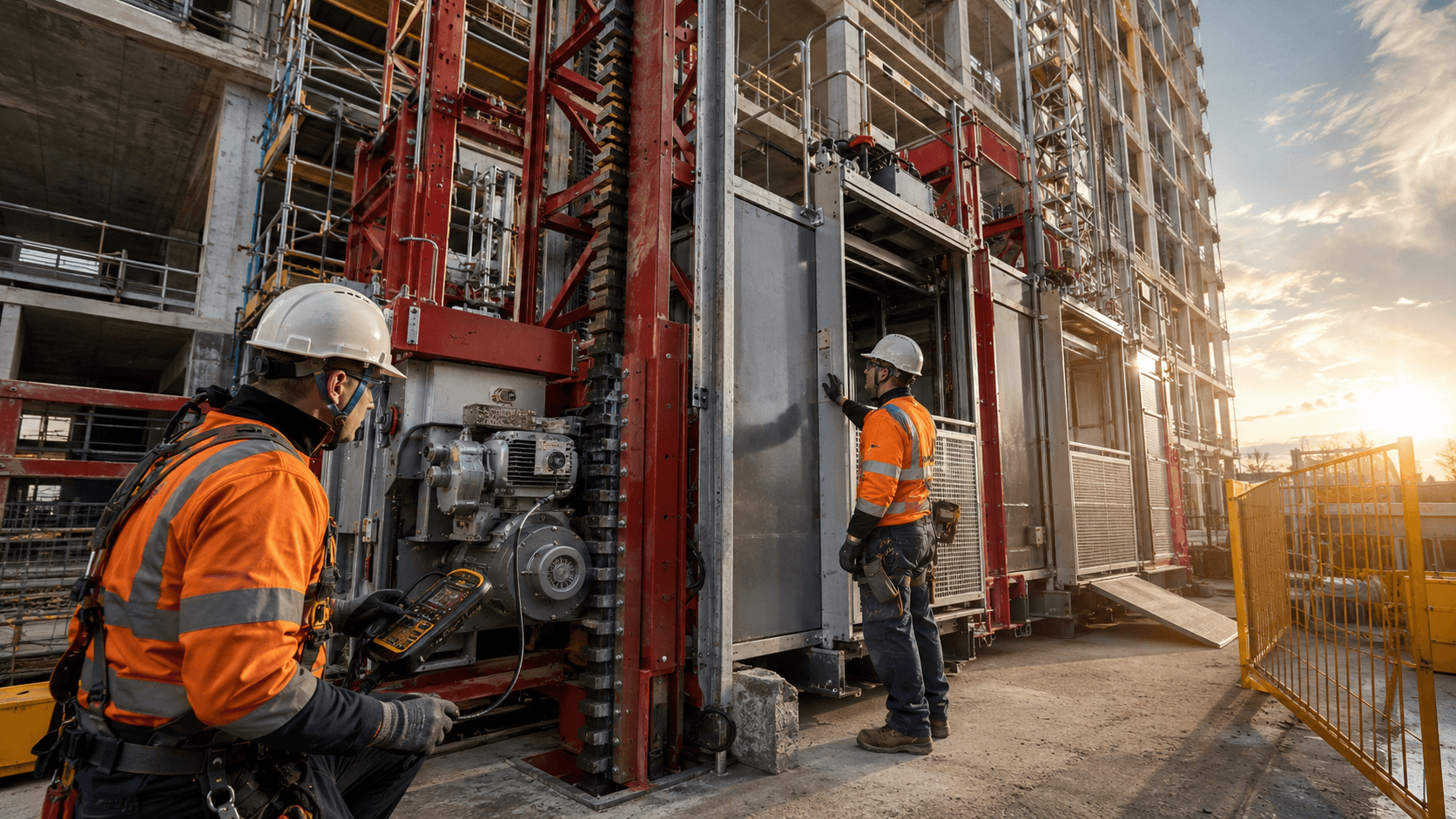
This qualification confirms occupational competence in the erection, configuration, operation, maintenance and dismantling of hoists used on construction sites and client premises. It covers the full working cycle of a hoist installation: interpreting installation drawings and manufacturers' data, assessing whether ground conditions and the host structure are suitable, lifting and securing mast sections and car assemblies, installing and testing ties and anchors, routing and connecting cables and power supplies, carrying out functional and safety checks, and later isolating, releasing stored energy and dismantling the unit in the correct sequence for reuse or disposal.
It serves the construction plant installation sector, and specifically the hoist discipline within it — rack and pinion goods hoists, combined passenger and goods hoists, rope-operated goods hoists and transport platforms. Because the work involves lifting heavy assemblies into position at height and then relying on that installation to carry people or materials, the qualification places substantial weight on load handling, slinging and signalling, thorough examination and inspection criteria, defect classification and the formal handover of a machine to the people who will use it.
At Level 3, the qualification goes beyond installing to the person's own instruction. It also confirms the ability to diagnose faults across the machine's systems — power, transmission, hydraulic, pneumatic, electrical, electronic and operating ancillaries — and to plan, co-ordinate and supervise an installation or dismantling operation, allocating roles, inducting and monitoring the team, checking progress against programme and confirming that completed work meets the specified standard.
The qualification is entirely work-based. Evidence is generated from live installation and dismantling contracts rather than from classroom exercises, so learners are assessed while doing their normal job under normal site conditions. For employers, it provides documented confirmation that the people erecting and striking hoists on their sites have been observed working competently against national occupational standards. For individuals, it formally records a specialist skill set that is otherwise difficult to evidence.
Approved versions are closely aligned in structure. All current versions require a set of mandatory units and none require optional units to be selected. Some approved versions additionally list further units that a candidate may complete but which do not count towards the qualification, and the precise wording used to describe hoist-type endorsements can vary.
Qualification structures, unit wording and assessment requirements may vary slightly depending on the approved awarding organisation.
Who It's For
This qualification is aimed at people already working in hoist installation for a plant hire company, a specialist hoist contractor, a principal contractor's plant department or a manufacturer's field service operation. It suits an experienced installer who works with a degree of autonomy — reading the installation drawing, deciding how the lift will be rigged, and taking responsibility for the sequence of work — rather than someone learning the trade for the first time. Because several units address supervision, fault diagnosis and handover, learners generally need to be at a point in their career where they are trusted to lead or co-ordinate part of an installation crew.
Experienced hoist installers
The typical candidate erects, alters, climbs and dismantles hoists as a routine part of their job, works from manufacturers' installation manuals and method statements, and is competent with lifting accessories, torque and fixing requirements, tie and anchor installation and the pre-use checks a hoist must pass before it is put into service.
Installers taking on co-ordination duties
The qualification also suits installers who have begun to organise the work of others — briefing a team before a mast climb, agreeing individual roles, monitoring health and safety on the installation, checking progress against the programme and reporting deviations. Candidates should be able to access this kind of responsibility during the assessment period.
Workplace and employment arrangements
Learners must have genuine, ongoing access to hoist installation work throughout their assessment. That normally means employment with a hoist or plant installation contractor, but self-employment or a sub-contract arrangement is equally acceptable provided the learner is working on real installations, can be observed on site by an assessor, and can obtain witness testimony from a supervisor or site contact. Without live hoist work, the required evidence cannot be produced.
Endorsements and Occupational Specialisms
This qualification does not offer separate pathways in the sense of alternative unit combinations. Instead, the specialism is recorded through endorsements applied to individual units, which identify the type of hoist and the technical areas in which the learner has actually been assessed. The endorsements matter in practice: two people holding the same qualification title may have been assessed on quite different machines. Learners should agree the endorsements with their assessor at the start, because they must be supported by real work during the assessment period. Endorsement wording and the level of detail recorded can vary between approved versions.
Hoist type endorsement
Most of the hoist-specific and plant units carry a hoist type endorsement, and at least one type must be evidenced. The recognised categories reflect the machines commonly used on UK sites: goods-only rack and pinion hoists, combined passenger and goods hoists, rope-operated goods hoists, and transport platforms. The endorsement distinguishes the mast, drive, safety gear and access arrangements the learner has actually worked on.
Slinging and signalling endorsement
The slinging and signalling unit carries its own endorsement restricted to the learner's own area of work — slinging and signalling in the context of hoist installation, rather than general lifting operations. This confirms competence in attaching mast sections, base frames and car assemblies to lifting equipment and directing their movement, without implying a wider slinger-signaller entitlement across other lifting disciplines.
Plant system endorsements for fault diagnosis
The fault diagnosis unit requires evidence across several distinct machine systems, selected from areas such as power units, transmissions, steering, hydraulics, pumps, brakes, pneumatics, electrical systems, electronic systems and operating ancillaries or attachments. The combination recorded depends on the machines the learner works on and the faults that arise during the assessment period.
Workplace Requirements
Because simulation is not permitted for the competence elements, the workplace must be able to supply real occupational opportunities across the whole installation cycle. A learner who only ever attends a hoist to carry out routine servicing will not be able to complete the qualification, however skilled they are.
Learners need access to:
Live hoist installation and dismantling contracts on construction sites or client premises, including at least one recognised hoist type
Manufacturers' installation and dismantling manuals, general arrangement drawings, schedules, risk assessments and method statements
Lifting equipment, lifting accessories and lifting aids, together with valid certification and reports of thorough examination
Hand tools, portable power tools, measuring and levelling equipment, torque equipment and specialist installation tooling
Diagnostic and testing equipment appropriate to the machine's systems, such as multimeters, pressure and flow gauges and test lamps
Access equipment and fall protection appropriate to work on and around a mast
Tie and anchor components, fixings, cables and power connection arrangements
Inspection, maintenance, handover and defect reporting documentation used by the employer
Opportunities to organise and monitor the work of other people during installation or dismantling activities
An assessor must be able to visit the site to observe work in progress, so employers should be prepared to grant site access and to allow a supervisor or colleague to provide witness testimony where an assessor cannot be present.
Learning Outcomes
The outcomes below describe what a learner who completes this qualification has demonstrated in the workplace across the full range of hoist installation activity.
Interpret installation drawings, schedules, manufacturers' manuals, method statements and risk assessments, and identify where information is inadequate or resources are unsuitable
Assess site conditions for suitability, including layout, available space, levels, the host structure and prevailing weather
Select lifting accessories, fixings, anchors, consumables, measuring equipment and tools appropriate to the installation
Sling, guide and land mast sections, base frames, car assemblies and components, using recognised hand signals and communication equipment
Install a hoist to specification: align, secure and pin or bolt components, fix to load-bearing structures, install and test ties and anchors, route and connect cables and power supplies
Configure a hoist for the specific operational requirements of the contract and adjust it for correct function
Prepare and operate a hoist during installation activities, including pre-use checks, functional and operational checks, confirmation of stability and security, and safe shutdown
Carry out basic maintenance to manufacturers' schedules and complete the associated records
Inspect a hoist for operational serviceability, distinguish between inspection, test and thorough examination, identify wear, damage and leaks, and classify critical and non-critical defects
Diagnose faults across several machine systems, determine the cause, judge the implications for safety and other work, and mark, tag or isolate equipment deemed hazardous
Dismantle a pre-installed hoist in the correct sequence, releasing stored energy safely, marking components to aid re-assembly and segregating parts for reuse or disposal
Plan and co-ordinate installation and dismantling activities, allocate roles, brief and monitor the team, and check progress and quality against the specification
Apply health, safety, welfare and environmental controls, including work at height, manual handling, waste disposal and site security requirements
Communicate with team members, other occupations, clients and site personnel, and complete records, reports and handover documentation
Units
Current approved versions of this qualification are built entirely from mandatory units — there is no optional group to choose from, and every learner completes the same set of competence areas. What varies between learners is not the units but the endorsements recorded against them. Some approved versions also list further units, such as operating hoists to lift and transfer loads, handing over plant to the control of others, and providing technical advice to users, which a candidate may complete for their own development but which do not contribute towards achievement of the qualification. Availability of these additional units is not universal.
The mandatory units are outlined below.
- Comply with induction information, safety notices, warning signs and displayed statutory requirements
- Use collective protective measures, personal protective equipment, respiratory protective equipment and local exhaust ventilation correctly
- Apply control measures identified by risk assessments and safe systems of work
- Identify hazards associated with resources, substances, obstructions, storage, services and work activities, and report changed circumstances
- Contribute to welfare arrangements, store safety equipment correctly and dispose of waste and consumables lawfully
- Explain organisational procedures for accidents, emergencies, evacuation, fire risk and safe exit, and identify appropriate fire extinguisher types
- Recognise when to stop work in the face of serious and imminent danger
- Support site security arrangements during the working day, on completion of work and in relation to unauthorised access or theft
- Interpret information relating to the movement, handling and storage of resources and to the use of lifting aids
- Explain responsibilities when working at height, below ground level, in confined spaces and when handling materials mechanically or manually
- Use lifting aids and kinetic handling techniques appropriately
- Select resources and describe the characteristics, quality, limitations and defects of handling aids, containers and securing systems
- Protect resources and the surrounding area from damage and maintain a clean working space
- Dispose of waste and packaging in accordance with legislation and explain environmental responsibilities
- Complete the work within the allocated time and report circumstances affecting the programme
- Move, handle and store a range of occupational resources, including components, tools and equipment
- Interpret installation manuals, drawings, specifications, schedules, method statements and risk assessments
- Assess the suitability of site conditions, including layout, location, available space, levels and prevailing weather
- Select lifting accessories, fastenings, ties, anchors, fixings, consumables and measuring and levelling equipment
- Confirm that parts, components, attachments and accessories are available to complete the installation
- Operate and control lifting equipment and lifting aids, and confirm the integrity of lifting accessories
- Measure, mark, align, level, plumb, fit, connect, fix, fasten and secure components
- Secure components for movement and lift them into position, tying in, pinning, clamping, bolting and screwing as required
- Fix plant to load-bearing structures, and install and test anchors and ties
- Route, lay, connect and secure cables, pipes and hoses, and connect power supplies
- Make adjustments to achieve optimum operational function and complete functional, operational and safety checks
- Deal with damages and defects arising during installation, such as misaligned components, cracked casings, leaks and breakages
- Liaise with the client, customer or their representatives, and complete and maintain installation records
- Work at height, use access equipment and store materials, tools and equipment safely
- Extract configuration requirements from manufacturers' information, specifications and working instructions
- Select the components, attachments, tools and consumables needed for the configuration
- Set up, adjust and secure the machine to meet the specified operational requirement
- Confirm that the configuration matches the working instruction and the intended use of the machine
- Carry out functional, operational and safety checks following configuration
- Identify and report configurations that cannot be achieved safely or within the limits of the learner's authority
- Protect the work and surrounding area from damage and dispose of waste correctly
- Complete and maintain configuration records and communicate changes to those affected
- Interpret drawings, specifications, schedules and manufacturers' information relating to hoist use during installation
- Comply with instructions derived from risk assessments and method statements
- Explain responsibilities when working at height, below ground level and with tools, materials and mechanical lifting
- Identify the characteristics of the hoist being installed, erected, altered or dismantled
- Carry out pre-use checks and prepare, set up, check and adjust the machine for operational requirements, safety and security
- Complete functional and operational checks and confirm hoist and equipment stability and security
- Check, adjust, operate, manoeuvre, position and communicate throughout the activity
- Use ancillary equipment and machinery associated with the installation
- Shut down and secure the hoist at the end of the activity
- Respond to fires, spillages, injuries and other task-related emergencies within the limits of personal authority
- Explain accident reporting procedures and organisational security procedures for tools and equipment
- Comply with health and safety legislation and use personal protective equipment relevant to dismantling
- Explain the risks of dismantling at height, in confined spaces and below ground level
- Extract dismantling instructions, disassembly drawings and other specifications from relevant sources
- Ensure stored energy or substances are released safely and correctly
- Make all isolations and disconnections in line with approved procedures
- Mark components where appropriate to aid re-assembly
- Explain why the correct dismantling sequence matters and the consequences of departing from it
- Disassemble the hoist using correct tools, techniques and clearly defined procedures
- Take precautions to prevent damage to components, tools and equipment, and recognise the types of damage that commonly occur
- Use lifting equipment and lifting aids, and protect, store and secure specialist tools
- Label and store parts, components and sub-assemblies for reuse in approved locations
- Discard unwanted components and substances in accordance with approved procedures, including hazardous waste
- Deal promptly with problems within the limits of personal authority and report those that cannot be resolved
- Comply with legislation and organisational procedures applicable to maintenance, and use PPE and manual handling techniques correctly
- Explain risks arising from released substances, slippery surfaces and work at height during maintenance
- Extract the applicable maintenance schedule and related specifications, and describe typical schedules and intervals
- Interpret the information contained in manufacturers' operation and maintenance manuals
- Carry out basic maintenance to manufacturers' specification within the limits of personal authority
- Select suitable tools, equipment and consumables, and apply and replenish lubricants using appropriate techniques
- Work in the specified sequence and complete activities within the agreed timescale
- Carry out sensory, functional and safety checks before, during and after maintenance
- Follow procedures where maintenance cannot be completed or where defects are identified outside the planned schedule
- Complete maintenance records accurately and pass them to the appropriate person
- Explain the importance of service history records for operational efficiency, statutory compliance and customer requirements
- Dispose of waste materials and substances in accordance with approved procedures
- Interpret workshop manuals, technical service bulletins, parts manuals and regulations associated with inspection, examination and test
- Identify the applicable inspection criteria for the machine and the circumstances
- Complete routine daily and weekly checks, periodic inspections, and pre-use, delivery, post-use and off-hire inspections
- Distinguish between test, inspection and thorough examination
- Check the calibration of inspection tools and use specialist inspection and diagnostic equipment
- Identify deterioration, damage, excessive wear and leaks
- Distinguish critical from non-critical defects and classify the serviceability of the machine
- Take account of plant and machinery life expectancy when judging condition
- Record and report findings using the appropriate method and maintain inspection records
- Use access equipment and work at height safely while inspecting
- Protect the work and surrounding area from damage and dispose of waste lawfully
- Collect and collate information from operators and users on symptoms and problems, and review existing records
- Analyse information to define a diagnosis starting point and establish the most likely causes
- Observe operational functions and interpret sounds and smells as diagnostic indicators
- Collect and analyse data from multimeters, pressure and flow gauges, computers, test lamps, portable appliance testing equipment and other specialist aids
- Identify and diagnose functional and operational faults across several systems, such as power units, transmissions, steering, hydraulics, pumps, brakes, pneumatics, electrical, electronic and operating ancillaries
- Determine and suggest repair requirements for the faults identified
- Categorise faults as continual, intermittent or breakdown
- Select routine and non-routine diagnostic procedures according to the situation
- Determine the implications of a fault for other work and for the operational safety of the machine
- Report, mark, tag and place notices on systems and components deemed hazardous
- Complete functional, operational and safety checks and maintain diagnostic records
- Use hand tools, portable power tools, specialist diagnostic and testing tools, access equipment and work at height safely
- Interpret drawings, schedules, lift plans, method statements and manufacturers' information relating to the lift
- Organise the sequence of slinging and signalling operations and communicate with team members and other occupations
- Select lifting accessories, lifting aids, signalling and communication equipment, hand tools and ancillary equipment
- Inspect and prepare lifting accessories before slinging, and identify rejection criteria for removing accessories from service
- Interpret valid certification for maintenance, inspection and thorough examination of lifting equipment
- Consider load characteristics, including weight, centre of gravity and lifting points, to determine the slinging method
- Attach and sling loads securely, ensuring balance and stability, across a range of load types
- Attach and use load guidance equipment such as tag lines
- Determine and check the route of the load before and during the lift, including distances, clearances and landing position
- Recognise blind spots, potential crush zones and other limitations to operator visibility
- Guide, move, land and position suspended loads using hand signals, signalling equipment and electronic communication equipment
- Confirm load stability, security and release, then remove and store lifting accessories
- Distinguish slinging and signalling from directing and guiding the movement of vehicles, plant and machinery not engaged in lifting
- Protect the work and surrounding area from damage and complete the work within the allocated time
- Identify work methods and activities that make optimum use of resources
- Extract installation and dismantling procedures from a range of technical documents
- Prioritise designated work activities to achieve given objectives cost-effectively
- Agree and record individual roles and group responsibilities, and record agreed plans following organisational procedures
- Organise the work against given criteria and follow procedures for seeking assistance to resolve typical problems
- Establish and maintain effective working relationships and respond to requests for help or information
- Communicate work plans and activities regularly by spoken, written and electronic means, and adapt communication style to the audience
- Carry out regular progress checks to quantify deviations from the planned programme
- Confirm the circumstances of any deviation, agree corrective action and implement it
- Inform decision makers about progress, programme changes and changes to resource needs
- Identify required quality standards, check that work conforms and implement corrective action where it does not
- Allocate health, safety and welfare equipment correctly for the activity
- Induct people, check their competence and monitor them during installation and dismantling
- Monitor health, safety and welfare against statutory requirements and record non-compliant workplace conditions
- Explain the function and special procedures relating to specialist safety equipment used in plant installation and dismantling
- Explain how to avoid conflict, maintain good working relationships and keep people informed about the work
Assessment
Assessment is competence-based and takes place in the working environment, in line with the consolidated assessment strategy that applies to construction and the built environment. There is no examination and no fixed assessment timetable: the learner builds a portfolio of evidence over a period of live installation work, and the assessor makes judgements against the learning outcomes and assessment criteria for each unit, applying the agreed endorsements. Assessors must have verifiable, current industry experience relevant to the occupational area and must use a combination of assessment methods rather than relying on any single source.
Workplace observation
Direct observation by the assessor is the primary source of evidence for the practical criteria. The assessor attends site while the learner is erecting, climbing, configuring, inspecting or dismantling a hoist, and records what was done, on what machine, under what conditions. Observations are planned to capture the endorsed hoist type and, for the supervisory unit, occasions when the learner is genuinely directing others.
Professional discussion and questioning
Much of the underpinning knowledge — dismantling sequence and stored energy, the distinction between inspection and thorough examination, defect classification, fault categorisation, tie and anchor requirements, emergency response — is confirmed through structured professional discussion and oral or written questioning. This allows the assessor to test understanding that cannot be inferred from watching a task, and to probe how the learner would respond to circumstances that did not arise during the assessment period.
Work products and records
Naturally occurring documentation from the job forms a substantial part of the portfolio. Suitable work products include installation and dismantling method statements and risk assessments the learner has worked to, lift plans, marked-up general arrangement drawings, tie and anchor test records, pre-use and periodic inspection sheets, defect and fault reports, maintenance and service records, handover and acceptance documentation, and briefing or toolbox talk records evidencing the co-ordination of others.
Witness testimony
Where an assessor cannot be present — for example during an out-of-hours climb or a short-notice dismantle — testimony from a supervisor, site manager or occupationally competent colleague can corroborate what the learner did. Witness testimony supports rather than replaces observation, and the assessor must be able to authenticate the witness and their relationship to the work.
Restrictions on simulation
Workplace evidence of skills cannot be simulated. Practical competence must be demonstrated on real hoists, on real contracts, under real site conditions — training-centre rigs, mock installations and classroom exercises are not acceptable substitutes for the performance criteria. This is the single most important planning consideration for anyone considering the qualification, because a learner without access to live hoist installation and dismantling work cannot complete it regardless of their experience.
Recognition of prior learning
Evidence generated before registration may be considered where it is authentic, current, sufficient and directly relevant to the assessment criteria, and where its authorship can be verified. Recognition of prior learning is assessed case by case and does not remove the requirement for the assessor to observe current workplace performance.
Achieving the qualification
To complete the qualification, a learner must satisfy all the assessment criteria in every mandatory unit, with the required endorsements applied, and the evidence must be judged consistent — showing that competence is repeatable across occasions and machines rather than achieved once. Internal quality assurance confirms that decisions were made by suitably qualified and occupationally competent assessors, and external quality assurance samples those decisions.
Career Progression
Progression from this qualification tends to follow one of two directions: deeper technical specialisation within lifting and access plant, or movement into co-ordination and supervision. Both build on the same foundation of installation competence, and both depend on continued experience, employer opportunity and, in some cases, additional operator or scheme requirements. The qualification records competence; it does not by itself guarantee a role, promotion or particular level of earnings.
Hoist installation roles
The most direct route is continued work as a hoist installer or senior installer with a hoist manufacturer, plant hire business or specialist installation contractor, taking responsibility for larger or more complex installations, including combined passenger and goods machines and transport platforms.
Related plant installation specialisms
The installation, inspection, fault diagnosis and slinging units transfer readily to adjacent disciplines within construction plant installation, such as tower crane erection and dismantling or mast climbing and access equipment. Moving into another machine type normally requires further assessment against that specialism, since endorsements are machine-specific.
Technical and service roles
Experienced installers often move towards service engineering, inspection and examination work, or technical support roles advising users and hirers on machine operation, maintenance requirements and defect rectification. Some of these positions carry additional certification or scheme requirements set by the employer or by statutory examination arrangements.
Supervisory and management routes
The supervisory unit within this qualification provides a foundation for lead installer, installation supervisor or contracts co-ordinator roles. Learners intending to move fully into supervision or site management generally progress to a separate supervisory or management qualification at the appropriate level, as this qualification remains anchored in the hoist installation occupation rather than in general site supervision.
FAQs
The questions below address points that come up repeatedly in relation to this particular qualification, especially around access to work, endorsements and what can and cannot be evidenced.
Yes. The endorsement structure requires evidence against at least one recognised hoist type, so a learner who works exclusively on rack and pinion goods hoists, for example, can complete the qualification with that endorsement recorded. It is worth being aware that the endorsement identifies what you were actually assessed on, and employers sometimes look at that detail rather than the title alone.
Either arrangement works, provided you have continuing access to genuine hoist installation and dismantling work. What matters is that an assessor can observe you on site, that you can supply work products from real contracts, and that someone in a position to comment on your work can provide witness testimony. Sub-contractors and self-employed installers regularly complete work-based qualifications on this basis.
No. Workplace evidence of skills cannot be simulated for this qualification. Practical competence must be demonstrated on hoists in a live working environment. Training-centre activity may support your knowledge development, but it cannot be used in place of observed performance on real installations.
It may be. One of the mandatory units addresses supervising and co-ordinating installation and dismantling activities, including allocating roles, inducting and monitoring people, checking progress against programme and confirming quality. You need access to that level of responsibility during the assessment period, even if it is limited to leading a small crew on part of an installation. This is worth discussing with your employer before you start.
Within this qualification, the slinging and signalling unit is endorsed for the hoist installation context — attaching and directing the mast sections, base frames, car assemblies and components that make up the installation. It confirms competence in that specific area of work rather than conferring a general entitlement to sling and signal across all lifting operations, which is assessed separately.
It expects structured diagnosis rather than fault reporting. You need to gather symptom information from users and records, work out the most likely cause, use diagnostic equipment such as multimeters and pressure gauges, identify the fault across several of the machine's systems, judge what it means for the safety of the equipment and other work, and take the appropriate action to mark, tag or isolate the machine. Evidence must span more than one system, so a range of faults occurring naturally during the assessment period is helpful.
The Level 2 qualification concentrates on carrying out hoist installation work competently to instruction. This Level 3 qualification retains that practical core but adds diagnostic and supervisory responsibility — diagnosing faults across machine systems, classifying serviceability and defects, and planning, co-ordinating, monitoring and quality-checking the installation or dismantling operation and the people carrying it out.
No. Current approved versions are made up entirely of mandatory units, and all learners complete the same competence areas. Some approved versions list further units that a candidate may complete for development purposes, but these do not contribute towards achievement of the qualification and their availability is not universal.
Application Form
Apply Now For This Course
An adviser will review your eligibility for Level 3 NVQ Diploma in Plant Installations and Hoists and reply within 1–2 working days.
Qualification Includes:
 Level3
 Lessons8
 CertificationYes
 Students1450
Related Diplomas
More qualifications in Plant, Lifting, Access and Machinery that may suit a similar workplace role.
.jpg&w=3840&q=75)
.jpg&w=3840&q=75)
.png&w=3840&q=75)
Featured Qualifications
Popular NVQ pathways learners often explore next.
.png&w=3840&q=75)
.png&w=3840&q=75)
