







Level 3 NVQ Diploma in Plant Installations and Tower Cranes
Workplace-assessed Level 3 Diploma confirming competence in installing, configuring, dismantling and supervising tower crane installations.
Overview
This qualification confirms occupational competence for people who erect, climb, configure, alter and dismantle tower cranes on construction sites and client premises. It sits within the plant installations occupational area rather than plant operations: the focus is on the assembly and structural integrity of the crane itself — bases and ballast, mast sections, slewing assembly, jib and counter-jib, ties and anchors, ancillaries and safety devices — rather than on the routine lifting duties an appointed operator carries out once the machine is handed over.
The work it recognises is technically demanding and heavily regulated. Learners interpret manufacturers' erection manuals, disassembly drawings, lift plans, method statements and risk assessments; establish that ground conditions, space, access and prevailing weather are suitable; use lifting equipment and lifting accessories to place mast sections and structural components; align, pin, bolt and secure assemblies; route and connect power supplies and control cables; install and test anchors and ties; and complete functional, operational and safety checks before the crane is released for use. Dismantling is treated as a discipline in its own right, including safe release of stored energy, correct isolation and disconnection, marking of components to aid re-assembly, and the correct sequence of disassembly.
At Level 3 the qualification also carries genuine responsibility for other people. It includes supervising and co-ordinating installation and dismantling activities — planning the work, allocating roles, monitoring progress and quality against schedules, inducting and monitoring the team, and recording workplace conditions that fall short of statutory requirements. Alongside this sits substantial slinging and signalling content, reflecting that erection crews routinely rig, guide and land their own components and sub-assemblies.
Because it is a competence-based NVQ, it is achieved through evidence generated from real erection and dismantling contracts rather than through classroom study. For workers, it provides formal, portable recognition of a specialism that is otherwise difficult to evidence. For employers, it produces a documented record that erection personnel have been assessed against national occupational standards on live installations, which supports competence assurance obligations for lifting equipment work.
Current approved versions are built on a common core of ten mandatory competence areas. Some approved structures also publish additional units in the same occupational family which may be taken separately but do not count towards achievement of this Diploma.
Qualification structures, unit wording and assessment requirements may vary slightly depending on the approved awarding organisation.
Who It's For
This qualification is intended for experienced tower crane erection personnel who are already carrying out installation and dismantling work as their main occupation, and who hold enough responsibility on site to plan, co-ordinate and check the work of others. It is not an entry route into the occupation, and it is not intended for crane drivers whose role is limited to operating an installed machine.
Tower crane erection and dismantling crews
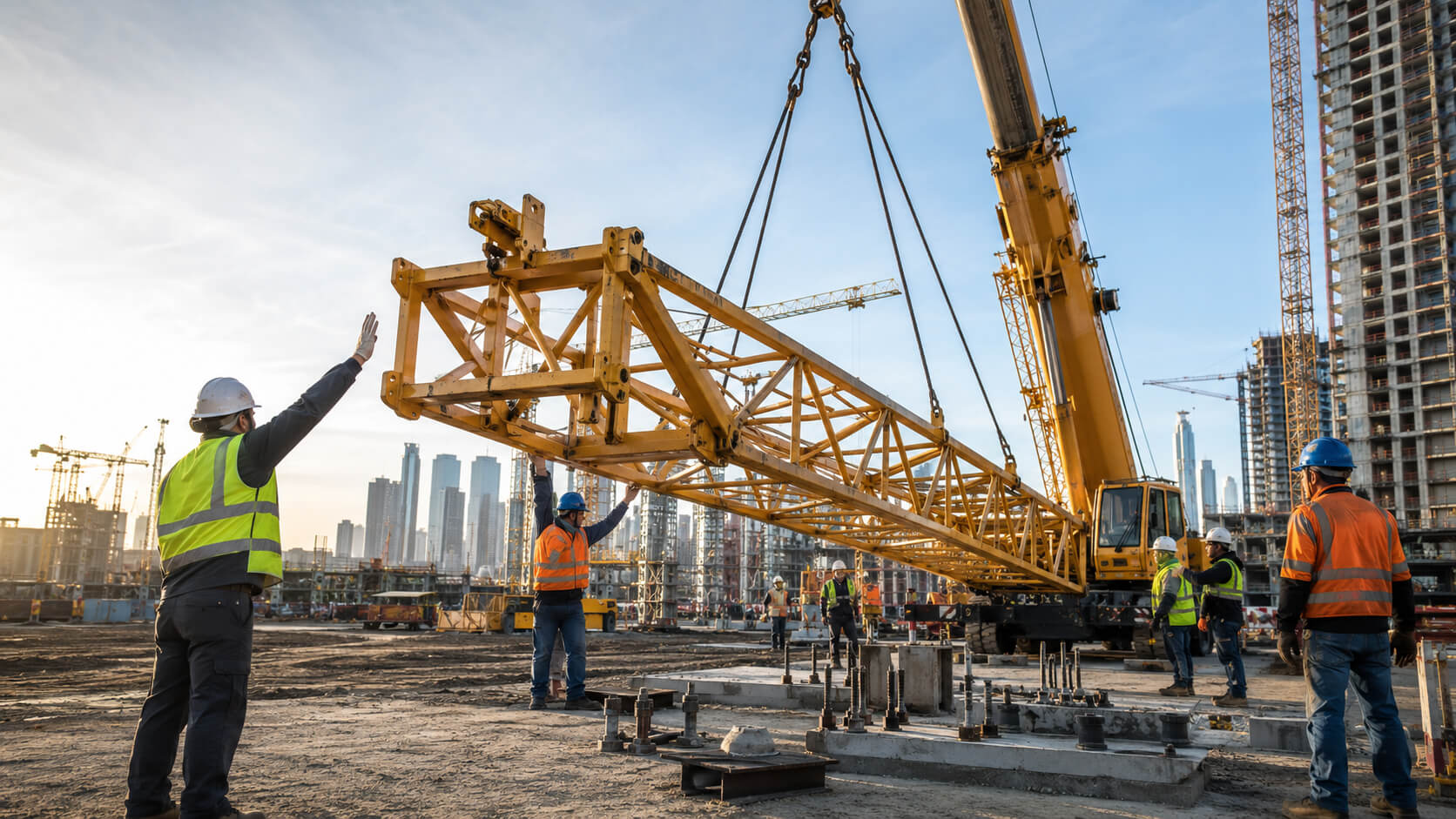
The primary audience is erectors working for crane hire companies, specialist erection contractors or major contractors who self-deliver crane installation. Typical activities include preparing the base, assembling and climbing the mast, rigging and placing jib and counter-jib sections, fitting ballast, installing ties to permanent structures, connecting power and control systems, and carrying out the reverse sequence at the end of the contract.
Experienced erectors taking on team responsibility
The supervisory content suits erectors who lead a small crew, brief the team against the method statement, prioritise the sequence of work, monitor progress against the erection programme and confirm that the installation meets the specified quality standards before handover. Learners need enough delegated authority for this to be evidenced genuinely rather than described in theory.
Workplace arrangements
Employment, or another genuine working arrangement such as self-employment under contract to an erection or crane hire company, is normally necessary. The learner must be in the role for the duration of assessment, because every performance requirement is drawn from real installation and dismantling contracts. Centres are expected to verify at the outset that the learner's job role and site access will allow all requirements to be met.
Endorsements and Occupational Specialisms
This qualification does not split into separate named pathways. Instead, individual units are assessed against occupational endorsements identified in the approved qualification structure, so that the certificate reflects the type of crane and the specific configuration activities the learner actually works on. Endorsement wording and combinations can differ between approved versions, and learners should confirm which endorsements their centre will assess before registering.
Self-erecting and assisted-erection tower cranes
Approved structures commonly distinguish between tower cranes that raise themselves using their own integral mechanisms and those erected with the assistance of a separate mobile or crawler crane. The two involve different planning assumptions, different lifting requirements and different risk controls, and the erection units are typically endorsed to show which type the learner has been assessed against.
Configuration activities
The configuration unit is assessed against a defined number of specific configuration areas rather than the crane as a whole. These may include attachments and ancillaries, structural support such as anchors and ties, safety measures such as restricted movement devices, warning alarms, notices, lights and governors, fire prevention provisions, contaminant reduction, machine control systems, additions such as signage and lighting, rail and trackside arrangements, and productivity measurement devices. The areas evidenced depend on the machines and contracts available to the learner.
Slinging and signalling within crane installation
The slinging and signalling requirement is endorsed to the erection context rather than to general site lifting, reflecting that the loads being rigged are crane components and sub-assemblies moved during installation and dismantling operations.
Workplace Requirements
Access to live tower crane installation work is the single biggest practical requirement of this qualification, and it cannot be substituted. Learners need to be working on contracts where cranes are actually being erected, climbed, altered or dismantled during the assessment period, since several units can only be evidenced while a machine is in a partially assembled state.
To generate valid evidence, learners normally need:
Real erection or dismantling contracts on construction sites or client premises, not decommissioned machines in a yard used purely for demonstration.
Manufacturers' erection and disassembly documentation, technical bulletins, parts manuals and the approved method statement, lift plan and risk assessments for the installation.
Access to appropriate lifting equipment and a range of lifting accessories, together with the certification and thorough examination records that must be interpreted before use.
Structural components and ancillaries relevant to the endorsements being claimed, including ties and anchors where structural support is being evidenced.
Working at height provision and access equipment appropriate to mast and jib work, and the health and safety control equipment identified by the risk assessment.
Hand tools, portable power tools, torque and measuring equipment, and the specialist tools used for pinning, bolting and alignment.
Sufficient delegated authority to organise the sequence of work, brief and monitor the crew, and stop or escalate work where conditions do not comply.
Access to the organisation's inspection, maintenance and handover records, so that documentation requirements can be met from genuine paperwork.
Where a learner's employer only carries out one type of erection, the endorsements available will be limited accordingly, and this should be agreed with the centre at initial assessment rather than discovered part-way through.
Learning Outcomes
The outcomes below describe what a successful learner can do in the workplace on completion. They are drawn from the occupational standards underpinning the current unit structure.
Interpret erection and disassembly drawings, specifications, schedules, installation manuals, workshop manuals, technical service bulletins, parts manuals and manufacturers' information for tower cranes.
Comply with the instructions and control measures derived from risk assessments, method statements and lift plans, and report information or resources that are unsuitable.
Plan and prioritise installation and dismantling activities, agree individual roles and group responsibilities, and record work plans in line with organisational procedures.
Assess whether site conditions — layout, available space, levels, access and prevailing weather — are suitable for the planned installation.
Select lifting accessories, fastenings, ties, anchors, consumables, measuring and levelling equipment, hand tools and portable power tools appropriate to the task.
Install tower cranes and associated plant, securing components for lifting, aligning and fixing assemblies by pinning, clamping, bolting and screwing, and fixing to load-bearing structures where required.
Install and test anchors and ties, and route, lay, connect and secure cables, pipes, hoses and power supplies.
Configure the crane for operational use against the required parameters, including attachments, ancillaries, structural support and safety devices.
Prepare and operate tower cranes during installation activities, including pre-use checks, set-up and adjustment, functional and operational checks, and safe shutdown and securing.
Sling, guide, move and land suspended loads using lifting accessories and recognised signalling methods, taking account of centre of gravity, lifting points, route, clearances and landing position.
Inspect plant and machinery for operational serviceability, distinguishing between test, inspection and thorough examination, and classifying critical and non-critical defects.
Carry out basic maintenance to manufacturers' schedules on installed plant and equipment.
Dismantle pre-installed tower cranes in the correct sequence, making safe isolations and disconnections, releasing stored energy safely, and marking components to aid re-assembly.
Segregate parts and sub-assemblies for reuse, and dispose of unwanted components and substances through approved routes.
Monitor progress and quality against schedules, identify deviations, implement corrective actions and inform decision makers.
Monitor health, safety and welfare during installation and dismantling, induct and check the competence of those involved, and record non-compliant workplace conditions.
Communicate work plans and changes to the crew, other occupations, clients and their representatives using spoken, written and electronic methods.
Complete and maintain inspection, maintenance and installation records to organisational and statutory requirements.
Units
The current structure is built entirely from mandatory units — there is no optional group to choose from, and all competence areas must be achieved. Ten units make up the qualification, combining general construction requirements, the specialist tower crane erection and configuration content, lifting and slinging competence, inspection and maintenance, and a Level 3 supervisory unit. Endorsements attached to individual units determine the crane types and configuration areas evidenced, and endorsement wording can vary between approved structures. Some approved structures publish further units in the same occupational family, such as fault diagnosis or providing technical information and guidance to plant users, which may be taken as additional units but do not contribute to achievement of this Diploma.
- Comply with workplace inductions, safety and warning notices and statutory requirements applying to the site and to erection equipment
- Use health and safety control equipment safely, including collective protective measures, personal protective equipment, respiratory protective equipment and local exhaust ventilation
- Comply with control measures identified by risk assessments and safe systems of work
- Identify hazards created by changing circumstances and report them through organisational procedures
- Recognise when work must be stopped in the face of serious and imminent danger
- Contribute to discussions and feedback on health, safety and welfare, and to the upkeep of welfare facilities
- State the organisational procedures for accidents, emergencies, evacuation, fire risks and safe exit
- Identify the appropriate types of fire extinguisher for the work and when each is used
- Support site and organisational security arrangements during and on completion of the working day
- Interpret technical, product and regulatory information relating to moving, handling and storing resources and to the use and storage of lifting aids
- Describe responsibilities under current legislation when working at height, in confined spaces, below ground level and with mechanical lifting
- Use lifting aids and health and safety control equipment safely and appropriately
- Select resources and describe the characteristics, quality, limitations and defects associated with lifting and handling aids, containers, and fixing, holding and securing systems
- Move, position, store and secure components, tools and equipment to product information and organisational requirements
- Protect resources and the surrounding area from damage and maintain a clean working space
- Dispose of waste and packaging in accordance with legislation
- Complete the work within the allocated time and report circumstances affecting the programme
- Interpret and extract information from drawings, specifications, schedules, method statements, risk assessments, installation manuals and manufacturers' information
- Assess the suitability of site conditions for installation, including layout, location, available space, levels and prevailing weather
- Select lifting accessories, fastenings, ties, anchors, consumables, measuring and levelling equipment and appropriate tools
- Confirm the integrity of lifting accessories and the availability of parts, components, attachments and accessories needed to complete the installation
- Operate and control lifting equipment and lifting aids during installation
- Secure parts and components for movement and lifting into position
- Align, attach and secure components by tying in, pinning, clamping, bolting and screwing, and fix plant to load-bearing structures
- Install and test anchors and ties
- Route, lay, connect and secure cables, pipes and hoses, and connect power supplies
- Make adjustments to achieve optimum operational function
- Complete functional, operational and safety checks to given working instructions
- Deal with damages and defects arising during installation, including misaligned components, cracked casings and housings, leaks and breakages
- Work at height using appropriate access equipment
- Liaise with clients, customers and their representatives, and complete and maintain installation records
- Interpret drawings, specifications, schedules, method statements, risk assessments, workshop manuals, technical service bulletins, parts manuals and manufacturers' information relating to configuration
- Assess the configuration requirements for the operational activity and validate how the work should be carried out
- Configure the crane against the endorsed areas, which may include attachments, ancillaries, structural support such as anchors and ties, safety measures such as restricted movement devices, warning alarms, notices, lights and governors, fire prevention, contaminant reduction, carriage of additional equipment, rail and trackside arrangements, cutting equipment, additions such as publicity boards and lighting, machine control systems and productivity measurement devices
- Confirm that the required operating parameters are achieved for the specific activity
- Complete functional, operational and safety checks following configuration
- Identify faults and difficulties using diagnostic tools, methods or techniques, and establish their nature and likely causes
- Determine the type and nature of remedial work needed, and explain the implications of faults for safe and efficient operation
- Liaise with operators, clients and their representatives, and complete and maintain configuration records
- Interpret and extract information from drawings, specifications, schedules and manufacturers' information relevant to operation during installation
- Comply with information and instructions derived from risk assessments and method statements
- Describe responsibilities under current legislation when working at height, with tools and equipment and with mechanical lifting
- Use personal protective equipment correctly and explain the purpose and limitations of each type
- Identify the characteristics of the crane being installed, erected, altered or dismantled
- Carry out pre-use checks and prepare, set up, check and adjust the crane for operational requirements, safety and security
- Carry out functional and operational checks and confirm crane and equipment stability and security
- Demonstrate checking, adjusting, operating, communicating, manoeuvring and positioning skills during installation activities
- Use ancillary equipment and machinery
- Shut down and secure the crane, and respond appropriately to fires, spillages, injuries and task-related hazards
- Interpret drawings, specifications, schedules, risk assessments, method statements, lift plans, work instructions and manufacturers' information
- Organise resources and the sequence of slinging and signalling operations with team members and other occupations
- Select lifting accessories, lifting aids, signalling and communication equipment, hand tools and ancillary equipment
- Identify and interpret valid certification for maintenance, inspection and thorough examination
- Inspect and prepare lifting accessories prior to slinging, and identify the rejection criteria for removing accessories from service
- Consider load characteristics, including centre of gravity and lifting points, to determine the method of slinging
- Determine and check the route of the load before and during the lift, including distances, clearances and landing position
- Attach lifting accessories and sling loads securely, ensuring balance and stability
- Attach and use load guidance equipment such as tag lines
- Sling and guide balanced, unbalanced, loose, bundled, container and drum loads, and loads where the operator cannot observe the full movement path
- Communicate using hand signals, signalling equipment and electronic communication equipment, and confirm the agreed method of communication
- Recognise blind spots, potential crush zones and other limitations to operator visibility
- Land and position loads safely and securely, then remove and store lifting accessories
- Protect the work and surrounding area from damage and dispose of waste in accordance with legislation
- Interpret workshop manuals, technical service bulletins, parts manuals, schedules and the regulations associated with inspection, examination and test
- Select and use inspection equipment, consumables, hand tools, portable power tools and specialist equipment, and check the calibration of inspection tools
- Identify the applicable inspection criteria
- Carry out routine daily and weekly checks, periodic inspections by interval or hours run, and pre-use, delivery, post-use and off-hire inspections
- Distinguish between test, inspection and thorough examination
- Identify deterioration, damage, excess wear and leaks
- Identify non-critical and critical defects and classify the serviceability of the plant or machinery
- Take account of plant and machinery life expectancy
- Record and report findings using the appropriate method and to given working instructions
- Work at height using access equipment, and store tools and equipment safely on completion
- Identify and extract the applicable maintenance schedule and related specifications from manufacturers' manuals and organisational sources
- Outline maintenance schedules and durations for typical plant and equipment in the occupational area
- Carry out basic maintenance activities to manufacturers' specifications and within the limits of personal authority
- Select appropriate resources, tools and equipment, and apply and replenish lubricants using suitable techniques
- Carry out sensory, functional and safety checks before, during and after maintenance tasks
- Complete maintenance activities in the specified sequence and within the agreed timescale
- Follow procedures where maintenance cannot be fully completed or a defect is identified outside the planned schedule
- Complete maintenance records accurately and pass them to the appropriate person
- Handle and dispose of waste materials and substances in accordance with organisational procedures
- State the maintenance authorisation procedures specified by the manufacturer and the organisation
- Comply with health and safety legislation, regulations and company procedures applying to the dismantling of installed tower cranes
- State the health and safety issues and possible causes of injury when dismantling at height, in confined spaces and below ground level
- Identify and extract applicable information from dismantling instructions, disassembly drawings and other relevant specifications
- Establish and mark components to aid re-assembly
- Ensure that stored energy or substances are released safely and correctly
- Make all isolations and disconnections in line with approved procedures
- Explain the importance of dismantling in the correct sequence and the consequences of departing from it
- Disassemble cranes using the correct tools, techniques and clearly defined procedures
- Take precautions to prevent damage to components, tools and equipment, and describe the types of damage that can occur
- Use lifting equipment and lifting aids safely during removal of components
- Label and store parts, components and sub-assemblies for reuse in approved locations
- Discard unwanted components and hazardous and non-hazardous substances through approved procedures
- Deal with problems within the limits of personal authority and report those that cannot be resolved
- Identify work methods and activities that make optimum use of resources
- Extract relevant information from technical documents establishing installation and dismantling procedures
- Prioritise designated work activities to achieve objectives cost-effectively and efficiently
- Agree and record individual roles and group responsibilities, and record work plans following organisational procedures
- Organise installation and dismantling activities against given criteria, and seek assistance and advice to resolve problems
- Establish and maintain effective working relationships and respond to requests for help or information
- Communicate agreed work plans and activities using spoken, written and electronic methods
- Carry out regular checks to quantify deviations from planned progress, agree the circumstances and implement corrective actions
- Inform decision makers about progress, programme changes and changes to resource needs
- Identify required quality standards from relevant information sources and check that work conforms to them
- Identify work that fails to meet the specified standard and implement corrective action
- Ensure correct allocation of health, safety and welfare equipment for the activity
- Induct people, check they are suitably competent, and monitor them during installation and dismantling
- Monitor health, safety and welfare in accordance with statutory requirements and record workplace conditions that do not comply
- Explain how to create and maintain good working relationships and avoid conflict with colleagues, clients and other workers
Assessment
Assessment is competence-based and internally assessed by the centre, with external quality assurance by the awarding organisation. Every unit must be assessed in a real work environment and in accordance with the construction sector's consolidated assessment strategy, using an occupationally competent and appropriately qualified assessor who holds verifiable, current industry experience in this specialism. The learner builds a portfolio of evidence demonstrating that they meet the performance and knowledge requirements of each unit, drawn from tower crane installations they are genuinely working on. The qualification is graded pass or fail, and all ten mandatory units, with their required endorsements, must be achieved for certification.
Workplace observation
Direct observation by the assessor on live erection and dismantling contracts is the primary source of performance evidence. Observations typically capture base and mast work, component rigging and placement, the fitting and tensioning of ties and anchors, alignment and securing operations, configuration adjustments, functional and safety checks, and the controlled dismantling sequence including isolation and release of stored energy.
Work products and site documentation
Genuine paperwork generated by the installation provides strong supporting evidence. This may include the erection method statement and lift plan, task-specific risk assessments, manufacturers' erection and disassembly documentation, pre-use and periodic inspection records, defect reports, thorough examination and lifting accessory certification reviewed before use, maintenance and service history entries, tie and anchor test records, and completed handover documentation.
Witness testimony
Where an assessor cannot be present for every stage of a crane erection — which is common, given that installations are weather-dependent and often run to compressed programmes — testimony from a supervisor, appointed person, lift supervisor or contracts manager who observed the learner can corroborate performance. Witness evidence supports observation rather than replacing it.
Professional discussion and questioning
Underpinning knowledge is confirmed through structured professional discussion and oral or written questioning. This is used to explore the reasoning behind decisions: why a particular erection sequence was followed, how ground conditions and weather limits were judged, how load characteristics determined the slinging method, how a configuration fault was diagnosed, and what the consequences would be if procedures were not followed.
Supervisory evidence
The supervisory unit requires evidence of the learner directing others. Suitable material includes recorded work plans and role allocations, briefing and induction records, progress and quality checks, records of deviations and the corrective actions taken, communications with decision makers about programme or resource changes, and records of workplace conditions found not to comply with regulations.
Recognition of prior learning
Where a learner has relevant prior learning or experience, recognition of prior learning may be considered against specific requirements, subject to the awarding organisation's policy and to the evidence being valid, authentic, current, sufficient and reliable. It does not remove the requirement for competence to be demonstrated in the workplace.
Restrictions on simulation
Simulation is not permitted for workplace evidence of skills in these units. Erection, climbing, configuration, slinging and dismantling activities must be evidenced from real work on genuine installations, and a training-centre exercise on a static or decommissioned machine will not satisfy the performance requirements. This makes continuity of suitable work during the assessment period essential, and consistent performance is established by evidencing the required activities across more than one occasion and, where endorsements demand it, across more than one type of crane or configuration area.
Career Progression
Progression from this qualification generally follows one of two directions: deeper specialisation within crane erection and lifting, or a move into supervisory and planning roles where responsibility for the lifting operation as a whole is held. Routes into some of these roles depend on additional experience, employer authorisation, separate training or scheme-specific requirements, and achieving this Diploma alone does not guarantee entry to them.
Advanced crane erection roles
Experienced holders commonly move into more complex installations — taller free-standing configurations, tied and climbing cranes on high-rise structures, luffing jib machines in constrained city-centre locations, or multi-crane sites requiring anti-collision configuration. Depth of endorsement coverage and exposure to different manufacturers' systems tend to matter more than further qualifications at this stage.
Erection team leadership
The supervisory content supports progression to erection team leader or crew supervisor, taking responsibility for briefing, sequencing, monitoring and quality assurance of installation and dismantling operations, and for the interface with the site team and client representatives.
Lifting operations planning and supervision
Some erectors move across into the wider lifting discipline, supervising lifting operations or planning lifts. These roles are supported by separate competence qualifications in controlling lifting operations at higher levels, and by scheme requirements that sit outside this Diploma.
Related plant installation specialisms
The installation, inspection, maintenance and supervisory competence transfers to other categories of installed plant, including hoists, mast climbing platforms and other site-installed machinery, where separate occupational qualifications exist for the specific machine type.
Technical and management routes
Longer-term progression can lead towards plant management, contracts management or technical support roles within crane hire and erection businesses, typically supported by further study at higher levels in construction site supervision, construction management or related technical disciplines.
FAQs
The questions below deal with the points prospective learners most often need clarified about this particular qualification — especially the boundary between erection and operation, the workplace access it demands, and how endorsements affect what appears on the certificate.
No. This qualification is about installing, configuring, altering and dismantling the crane as a structure. It includes operating the crane during installation activities, but that is a limited operational role tied to the erection process. Competence to carry out routine production lifting duties as an appointed operator is covered by separate plant operations qualifications.
Effectively, yes. Every unit must be evidenced from real work, so learners need to be working in a tower crane installation role — as an employee, or through self-employment or another genuine arrangement with an erection or crane hire business. Centres are expected to confirm at the outset that the role and site access will allow all requirements to be met.
No. Workplace evidence of skills cannot be simulated for these units. Erection, configuration, slinging and dismantling must be evidenced from live installations. Training-centre activity may support knowledge development, but it cannot stand in for the performance requirements.
Approved structures typically require the erection units to be endorsed according to the type of crane worked on — cranes that raise themselves using integral mechanisms, or cranes erected with the assistance of a separate crane. The endorsement reflects the machines the learner has actually been assessed on, so learners whose employer works with only one type will be endorsed accordingly. Endorsement wording can vary between approved versions.
Because erection crews rig and guide the crane's own components and sub-assemblies. The slinging requirement is endorsed to the installation context and covers accessory inspection, load characteristics, route planning, communication methods and blind-load handling as they arise during erection and dismantling, rather than general production slinging.
A significant amount. The supervisory unit sits at Level 3 and requires evidence of planning the activity, agreeing roles, inducting and monitoring the crew, checking progress and quality against schedules, and recording conditions that fall short of statutory requirements. Learners without any delegated authority over the erection operation will struggle to evidence it.
Both sit within the plant installations occupational area and share the general health and safety, moving and handling, installation, inspection, maintenance and supervisory content. They differ in the machine-specific units: this version addresses tower crane erection, configuration, operation during installation and dismantling, whereas the hoist version addresses the equivalent activities on passenger and goods hoists.
Yes. Configuration is a mandatory Level 3 unit, and it must be evidenced against a defined number of specific configuration areas — for example structural support such as anchors and ties, safety devices, ancillaries or machine control systems. It also requires the learner to diagnose configuration faults and determine what remedial work is needed before the machine is released.
Application Form
Apply Now For This Course
An adviser will review your eligibility for Level 3 NVQ Diploma in Plant Installations and Tower Cranes and reply within 1–2 working days.
Qualification Includes:
 Level3
 Lessons15
 CertificationYes
 Students1152
Related Diplomas
More qualifications in Plant, Lifting, Access and Machinery that may suit a similar workplace role.
.jpg&w=3840&q=75)
.jpg&w=3840&q=75)
.png&w=3840&q=75)
Featured Qualifications
Popular NVQ pathways learners often explore next.
.png&w=3840&q=75)
.png&w=3840&q=75)
