








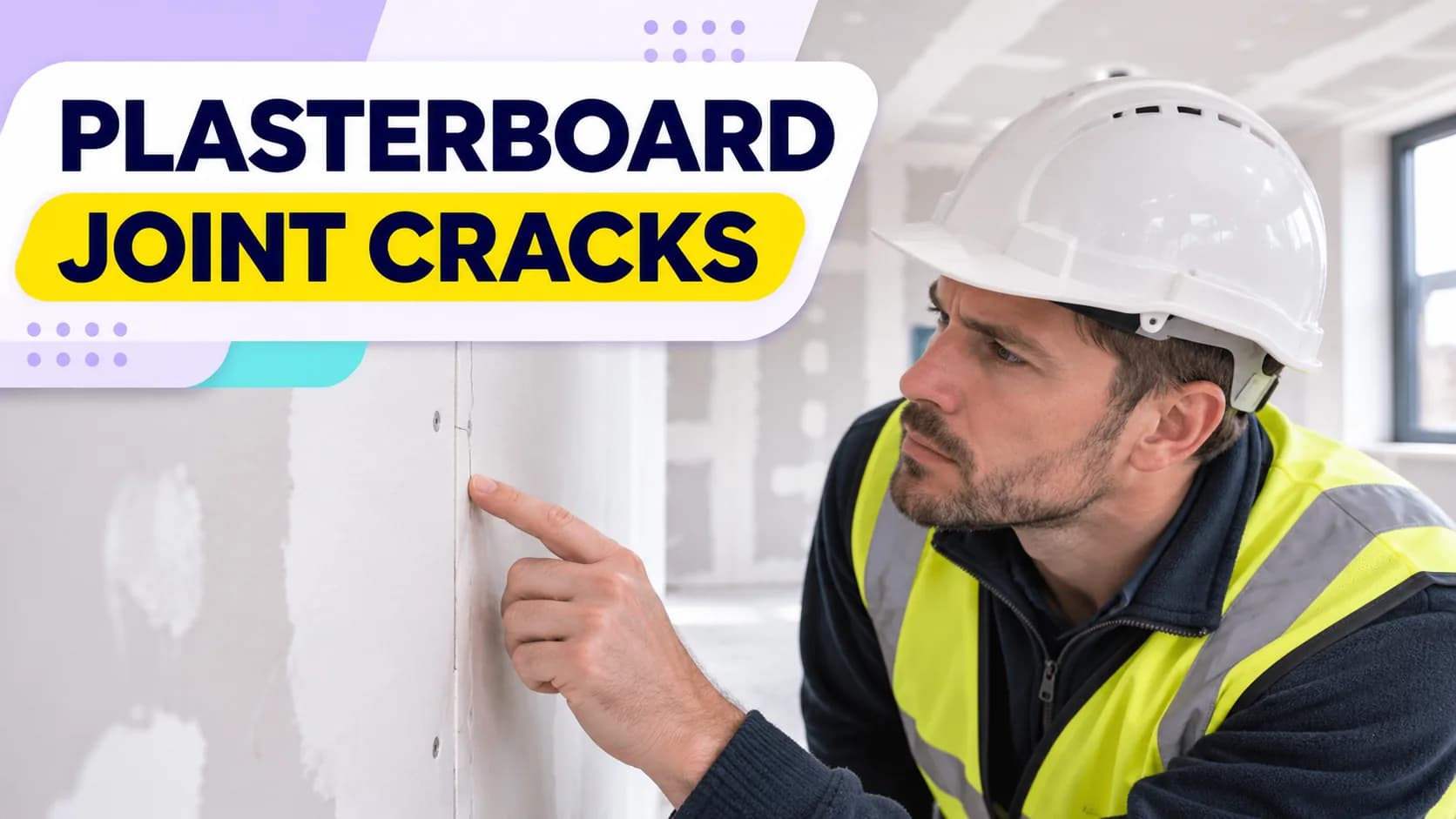
Plasterboard Joint Cracks: Causes and Prevention
Plasterboard joint cracks can result from movement, inadequate support or fixing, unsuitable joint treatment, or drying and environmental conditions. Before filling a crack, establish whether it follows a board joint, whether movement is continuing and whether the partition or ceiling has performance requirements that a repair must preserve.
This guide is for understanding defects and organising a competent assessment. It does not diagnose structural movement or prescribe a universal joint repair. Fire-resisting constructions, wet boards, loose ceilings and recurring or widening damage need appropriate specialist attention.
Record the crack before disturbing it
Map its location, direction, extent and relationship to board edges, corners, openings and fasteners. Note the date first observed and any changes. Take contextual photographs and record previous repairs.
A straight line may follow a board joint, but the line alone does not reveal the hidden support or reinforcement. Do not assume that a crack is harmless because it is narrow, or structural because it is visible. If boards are loose, sagging or affected by water, restrict the affected area and obtain competent assessment promptly.
Separate likely causes from symptoms
Use the following original review table to organise questions. It is not a diagnostic test or authority to open the construction.
| Observed pattern | Question for assessment |
|---|---|
| Repeated line along a board edge | Are support, fixing and reinforcement consistent with the system? |
| Cracks around openings | How are framing, board layout and movement detailed? |
| Recurring repaired joint | Was the underlying movement or support issue resolved? |
| Crack with staining or soft material | Is moisture affecting the board or substrate? |
| Failure near a head or junction | Is the specified movement detail being maintained? |
Record the evidence needed to distinguish causes. A repair product cannot correct an inadequately supported assembly or a detail that prevents required movement.
Check the complete jointing system
British Gypsum's White Book finishes guidance describes support, board condition, reinforcement and compatible jointing materials as part of finishing. Its details apply to the specified products and systems, not every board or filler on the market.
The manufacturer's Gyproc Joint Tape information explains the role of paper reinforcement in reducing cracking risk. Do not assume a different tape or an unreinforced filler gives equivalent performance. Product choice must suit the board, joint and specified system.
Distinguish setting from drying and check the actual product instructions. A material can be firm before it is ready for every subsequent operation. This article does not prescribe universal coat thicknesses, mixing ratios or drying times.
Consider movement and environmental history
Ask about the building's drying history, heating changes, water entry and construction sequence. Check whether the crack appeared after a relevant event, while avoiding conclusions based on timing alone.
British Gypsum's deflection-head guidance explains how selected partition details accommodate structural movement above. Filling or rigidly bridging a required movement provision can undermine its purpose. Refer uncertain junctions to the responsible designer.
For a wider coordination check, see the construction inspection and test plan guide. Hidden details need traceable acceptance before concealment, not just an attractive finished surface.
Decide what needs investigation before repair
A competent person should determine whether the defect is limited to the finish or reflects board, framing, fixing, moisture or structural problems. Obtain the original wall or ceiling specification and any approved changes where available.
Confirm whether fire, acoustic or other performance requirements apply.
Check available installation and inspection evidence.
Identify moisture damage and whether its source is active.
Assess safe access and hazardous materials before opening work.
Agree the repair scope and evidence needed for acceptance.
Do not cut an inspection hole into an unknown rated wall or ceiling without approval. A small opening can still affect the assembly and may expose services or hazardous existing materials.
Control dust and product exposure
HSE's joint-sanding guidance prioritises avoiding unnecessary sanding and using suitable on-tool extraction where sanding is needed. Plan the actual task, including occupants and nearby workers; a disposable mask alone is not a substitute for dust control.
As an example of product-specific evidence, the manufacturer's Gyproc EasiFill safety data sheet available when checked bears revision date 3 January 2020. It warns about dust irritation and avoiding inhalation. This longstanding document is not newly issued guidance and is not an endorsement of EasiFill for every repair.
Obtain the current instructions and SDS for the product actually selected. Use planned access equipment and safe handling; do not stand on makeshift furniture to reach a ceiling joint.
Illustrative example: a crack that returns after filling
A fictional room has been redecorated twice, but a line returns at the same board joint. The next assessment records the pattern and reviews support and joint-treatment information instead of immediately choosing a stronger filler.
If a concealed construction defect is identified, the competent repair scope addresses it and preserves the assembly's requirements. If continuing movement remains uncertain, that uncertainty is escalated. The scenario illustrates a decision process, not a diagnosis of every repeated crack.
Prevent recurrence through inspection and handover
Check the agreed substrate preparation, system components and environmental conditions during work. Record the repair location, products and relevant acceptance checks. Review the repaired area under appropriate lighting without promising an invisible finish under every lighting condition.
Keep the cause and any unresolved movement separate from cosmetic acceptance. People carrying out interior-systems work can explore the Interior Systems certificate against their actual work and evidence.
Editorial note: Prepared with AI assistance using the linked primary sources, checked on 15 November 2026. The tools and hypothetical examples are original learning aids. Source and consistency checks were performed; no independent practitioner review, firsthand project evidence or named contributor participation has been verified. The featured image is AI-generated.
Frequently Asked Questions
No, but appearance alone cannot rule structural or other consequential problems in or out. A competent assessment should identify the cause, especially where damage is changing, recurring or accompanied by loose or wet material.
Do not assume that it can. The specified joint system determines the reinforcement and compatible compounds. An unreinforced cosmetic fill may leave the underlying cause unresolved.
Possible reasons include continuing movement, inadequate support, unsuitable joint treatment or unresolved moisture. Reassess the cause rather than repeatedly covering the same line.
No. Cosmetic appearance does not establish fire, acoustic or structural performance. Confirm the approved repair detail, concealed work and necessary acceptance evidence.