








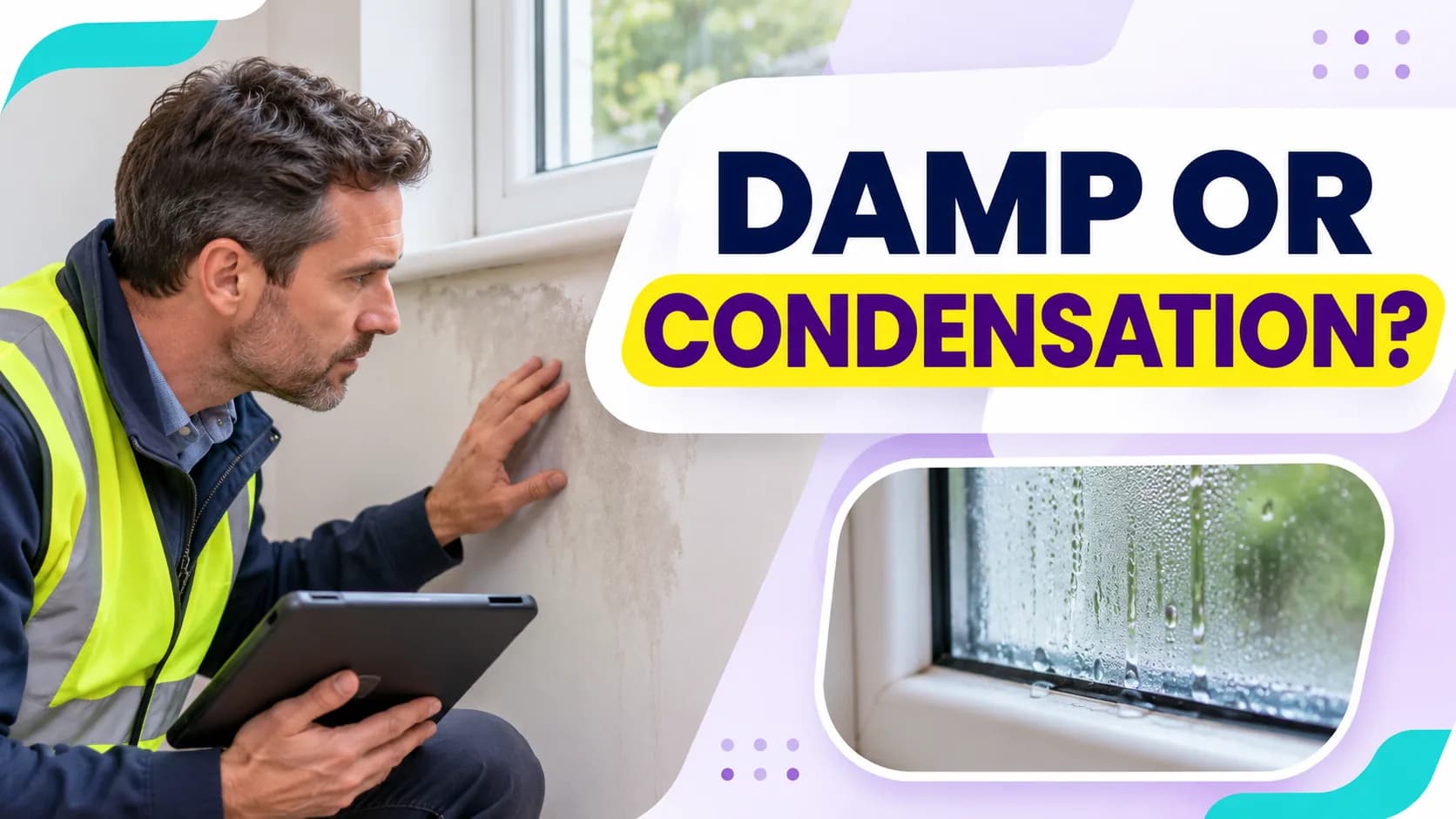
Rising Damp vs Condensation: How to Investigate the Cause
Rising damp involves moisture moving upward from ground contact; condensation forms when water vapour condenses on or within colder building elements. Similar staining can also come from rain penetration, plumbing leaks or other sources. Investigate the building and moisture pattern before selecting a treatment.
This guide helps owners and maintenance staff organise evidence for a competent damp investigation. It does not diagnose a property remotely or prescribe damp-proofing, insulation or mould removal. Traditional construction, occupied housing and vulnerable occupants require particular care.
Compare mechanisms without turning clues into proof
A low-level mark is not automatically rising damp, and mould near a window is not proof that occupants caused the problem. Several moisture mechanisms can affect one room. Start with possible sources and the pathways by which water reaches the affected material.
| Possible mechanism | Useful observations | Important limitation |
|---|---|---|
| Condensation | Cold surfaces, timing, ventilation and humidity patterns | Surface appearance alone does not explain the cause of cold or moisture |
| Rising moisture | Ground-contact construction, moisture profile and salts | A high electrical meter reading alone is insufficient |
| Rain penetration | Relationship with rainfall and external defects | Water can travel before appearing inside |
| Plumbing or other leak | Service routes, usage and changes over time | A visible patch may be remote from the source |
The SPAB rising-damp guidance warns against diagnosis based only on electrical moisture readings, particularly in old buildings. Salts and material differences can affect results. A number on a meter is evidence to interpret, not a treatment instruction.
Understand condensation in plain terms
Air contains water vapour. When conditions at a surface or within a construction allow vapour to condense, liquid water can accumulate. Surface temperature, moisture production, ventilation, heating and the building fabric interact.
SPAB's condensation guidance distinguishes surface condensation from moisture within building elements. A room can therefore have a problem that is not visible as droplets on its main wall surface. Ventilation and thermal changes need consideration as part of the whole building, not as isolated products.
Do not block designed vents, disconnect extraction or add insulation without checking the consequences. Nor should a repair plan simply instruct occupants to open windows while ignoring defects, inadequate systems or practical constraints.
Collect a useful history
Ask when the problem began, where it first appeared and what changed. Relevant events include leaks, alterations, replacement windows, external ground changes, new finishes and changes in use. Seek observations without blaming residents.
Map the location and photograph it with dates and context.
Record rainfall, seasonal or usage relationships where known.
Note affected materials, odour, salts, surface growth and deterioration.
Identify recent maintenance and any previous treatments.
Record missing information and the next investigation decision.
A log helps distinguish ongoing moisture from historic staining, but it must not delay urgent action to protect occupants. Keep personal health information appropriately restricted.
Inspect the building before ordering a treatment
A competent survey should consider the construction, external drainage, rainwater goods, ground levels, roof and wall defects, service leaks and ventilation arrangements as relevant. Use safe access and suitable specialists. Do not climb onto a roof or disturb concealed materials merely to complete an informal inspection.
Ask the investigator to state competing explanations, the evidence supporting each and what further tests would change the conclusion. Some investigations need moisture profiling or material sampling rather than a surface scan. Destructive work requires the appropriate permissions and hazardous-material assessment first.
Where an expensive or irreversible treatment is proposed on uncertain evidence, seek independent advice with suitable building-pathology expertise. For traditional buildings, confirm experience with moisture behaviour and compatible repairs.
Respond promptly where damp and mould affect occupants
The government's damp and mould guidance, updated 1 April 2026, applies to England and is aimed particularly at housing providers. It calls for prompt attention to underlying causes and health concerns rather than merely removing visible growth. It should not be treated as a universal timetable or legal summary for every jurisdiction.
Report the problem promptly through the relevant landlord or building-management route. Significant mould, recurring damp or health concerns warrant appropriate professional help. This article does not give chemical cleaning or remediation instructions; removing growth and repairing its cause are separate tasks.
Illustrative example: a low damp patch behind furniture
In a fictional dwelling, a resident reports a low wall patch behind a wardrobe. A surface meter gives elevated readings, and a contractor initially suggests an injected damp-proof course. The evidence review also finds a cold external corner and intermittent extraction problems.
The investigator checks construction, external conditions, services and the moisture distribution before deciding which mechanism is present. The example does not establish that the cause is condensation; it shows why one reading and one location cannot settle the diagnosis.
Judge a proposal by its evidence and consequences
A useful proposal explains the identified source, uncertainty, scope, expected outcome and follow-up evidence. Ask what happens to moisture pathways if an impermeable finish or barrier is introduced. Avoid choosing a treatment simply because it is marketed for a symptom.
For traditional fabric, repairs may need conservation advice and consent checks. Our lime mortar guide discusses compatibility, but does not imply that repointing is the solution to every damp wall.
Verify improvement rather than hiding the stain
Agree a review plan suited to the cause and conditions, record the works and inspect for recurrence. Redecoration alone cannot demonstrate that moisture has been controlled. Keep unresolved uncertainties visible in the building maintenance programme.
People working with building treatments can explore the Insulation and Building Treatments qualification. A qualification pathway or a single instrument reading does not replace a competent property-specific diagnosis.
Editorial note: Prepared with AI assistance using the linked primary sources, checked on 15 November 2026. The tools and hypothetical examples are original learning aids. Source and consistency checks were performed; no independent practitioner review, firsthand project evidence or named contributor participation has been verified. The featured image is AI-generated.
Frequently Asked Questions
No. A surface reading needs interpretation alongside the material, salts, location, construction and other evidence. Further investigation may be needed before a treatment can be justified.
Yes. Cold surfaces and restricted air movement can affect low areas as well as windows and corners. Location alone cannot distinguish condensation from ground moisture or a leak.
Not automatically. Establish the source and mechanism first, especially in traditional buildings. A proposed treatment should explain the evidence, limitations and consequences for moisture pathways.
No. The underlying moisture cause also needs attention. Significant or recurring growth and occupant health concerns require prompt appropriate action; this guide does not prescribe a cleaning chemical or remediation method.