








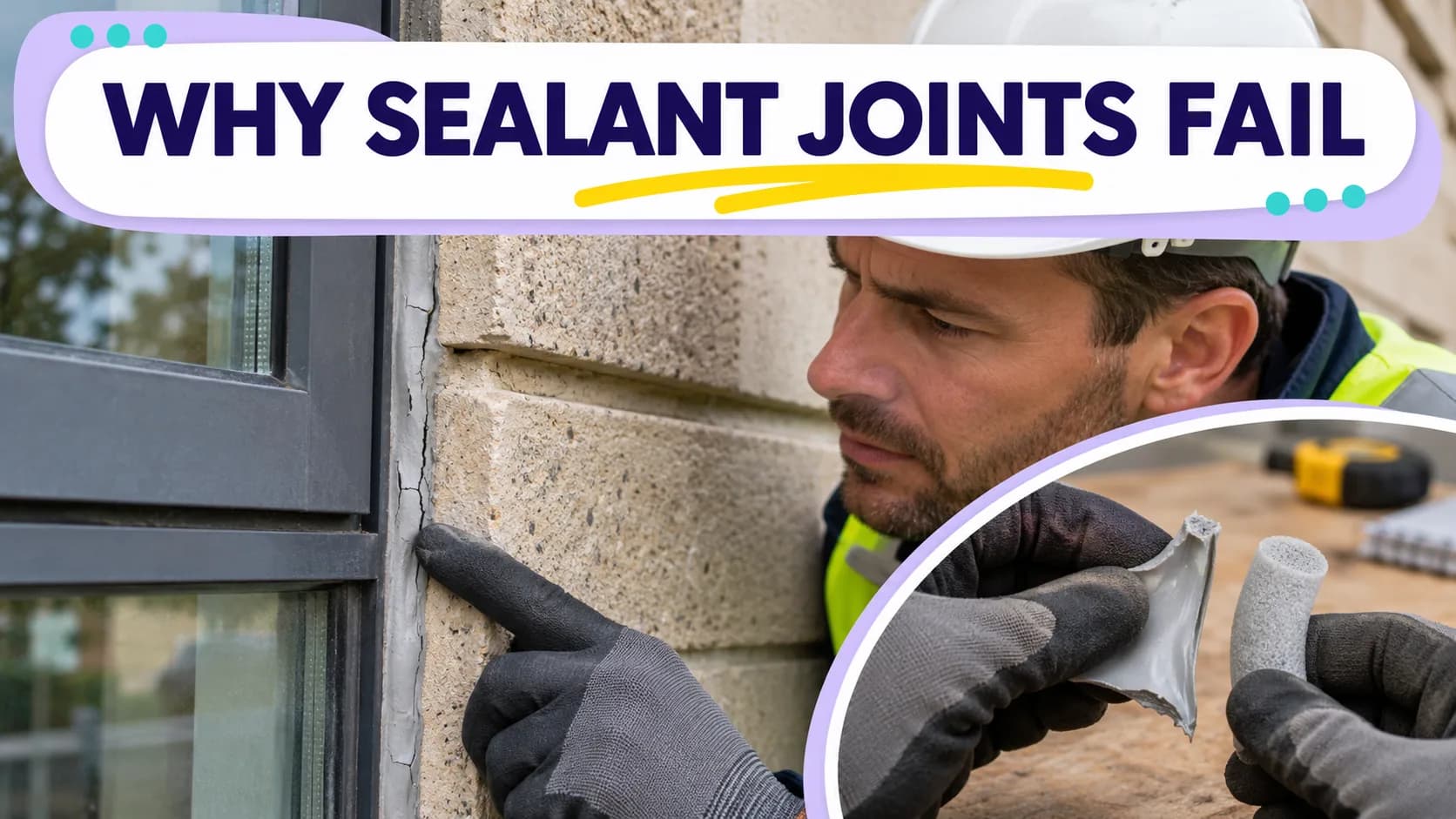
Construction Sealant Joints: Common Failures and Preparation Checks
Construction sealant joints commonly fail because the selected system cannot accommodate the movement, the sealant has not bonded to a sound surface, or the installed joint differs from the approved detail. Successful repair begins by identifying the failure and its cause. Applying a fresh bead over a split or detached seal rarely answers those questions.
This guide helps supervisors and learners inspect ordinary weather-sealing and movement joints and prepare a useful repair brief. Structural glazing, fire-resisting joints, submerged service and other specialist applications require their own tested or engineered systems. A general-purpose sealant is not an interchangeable substitute.
Read the failure before choosing the replacement
Describe what is visible without treating appearance as proof of a single cause. Adhesive failure means separation at the bond interface. Cohesive failure is a split within the sealant itself. Substrate failure means the surface material has broken away, sometimes leaving a layer attached to the bead. More than one mechanism can occur along the same joint.
| Observation | Questions to investigate | Useful next evidence |
|---|---|---|
Bead pulls away from one edge | Was that surface sound, compatible and correctly prepared? | Substrate identity, preparation record and adhesion-test result. |
Split through the bead | Does movement exceed the system design, or is the geometry unsuitable? | Joint dimensions, approved movement allowance and failure location. |
Dusty or weak material attached to sealant | Has the substrate surface failed? | Close photographs and a competent substrate assessment. |
Soft, uncured or damaged areas | Were storage, application and curing conditions suitable? | Batch, expiry, application date and exposure history. |
Staining beside the joint | Is there incompatibility, contamination or another water path? | Material compatibility advice and a mapped pattern of staining. |
Record where intact joints remain as well as where failures occur. A repeated problem at one material interface asks a different question from isolated damage beside a recent trade access route. Keep removed samples only under the agreed safe-work arrangements and label their locations.
Confirm the joint function and product limits
Joint width, depth, backing and sealant movement capability must work together. There is no safe universal width-to-depth ratio for every construction sealant. Ask for the project detail, expected movement, exposure and specified product before copying dimensions from another job.
The UK Sika Hybriflex SMP product information is a useful example of why product instructions matter: it gives different joint limits for trafficked and untrafficked applications and distinguishes damp surfaces from standing water. Those permissions belong to that product and use. They do not override another sealant manufacturer’s requirement for dry substrates or an approved project detail.
Check whether the joint also has acoustic, hygiene, chemical-resistance, traffic or fire requirements. Colour matching is a late selection decision; it cannot establish that the product has the required performance. Confirm compatibility with adjacent coatings, natural stone, plastics and any existing residues, using the manufacturer’s advice and appropriate trials.
Preparation checks before installation
Preparation is a sequence of verifiable conditions, not a quick wipe immediately before tooling. Sika’s surface-preparation guidance explains the importance of removing contamination and establishing suitable bonding surfaces. Its US product context must be read alongside the UK product sheet and the materials actually specified.
Identify the two intended bonding faces and the sound substrate beneath any failed material. Agree removal methods that will not damage the joint edges.
Remove the old sealant and incompatible residue to the extent required by the repair specification. A thin hidden film can matter even when the surface looks tidy.
Check for dust, grease, frost, moisture and weak coatings against the selected product’s requirements. Use approved cleaning methods and allow required drying or flash-off time.
Confirm the primer or activator for each substrate. “No primer required” for one surface is not permission to omit it everywhere.
Set the approved backing or bond-breaker arrangement and joint geometry. Check continuity at corners and terminations before the bead conceals them.
Complete the specified trial or adhesion check and record acceptance before extending the work.
Backing rod can help control sealant depth and prevent unwanted bonding at the back of the joint. Sika’s backing-rod information describes its role in avoiding three-sided adhesion. Choose a compatible backing type and installation detail for the actual system; do not force in an arbitrary rod or assume every cavity needs the same arrangement.
Control exposure before removing or applying materials
Review the sealant, primer and cleaner separately. The GB Hybriflex SMP safety data sheet, revised 24 September 2026 identifies skin sensitisation and environmental hazards. It specifies protective gloves and precautions against release. This is an example product assessment, not a statement that all sealants share the same hazards.
Some primers and cleaners contain solvents. HSE’s construction-solvent guidance supports considering safer alternatives and controlling vapour, skin and eye exposure. Specify ventilation, compatible protection and ignition controls as required by the actual products and assessment. A dust mask does not control solvent vapour.
Removal can introduce blade injuries, flying debris, hazardous dust and damage to concealed materials. Survey uncertain older materials before disturbance, select the removal method through the risk assessment and provide safe access to elevated joints. Do not turn a minor seal repair into uncontrolled grinding or work from an unsuitable platform.
Inspection during curing and at handover
Tooling should produce the specified contact and finish without introducing unapproved liquids or damaging the backing. A neat surface does not establish adhesion or full cure. Protect the joint from movement, water, cleaning or traffic for the period stated for the selected product and conditions. Surface skinning and through-curing are different milestones.
Keep a joint record containing location, drawing revision, actual geometry, substrates, sealant and primer identities, batch numbers, preparation checks, application conditions, trial results and release decision. Link significant checks to the construction inspection and test plan. This makes a later investigation more precise than a photograph of the finished bead alone.
An illustrative repair decision
Suppose a perimeter bead has detached from a painted frame but remains attached to the masonry. Replacing the sealant immediately assumes the bead itself was the only problem. A better enquiry asks whether the coating is sound and approved for bonding, whether residue remains and whether movement has been considered. If the paint is failing, a stronger primer over it does not resolve the weak layer. The repair detail needs an accepted bonding surface and a documented compatibility decision. This is a hypothetical example.
For learning and workplace evidence, the specialist installation occupations qualification provides relevant context. The separate guide to tiling movement joints explains why joints in tiled finishes also need their own coordinated design.
Scope and editorial method
This research-based guide was prepared with substantial AI assistance for research organisation and drafting. Linked primary sources were checked on 19 November 2026. No independent technical review, named practitioner contribution or firsthand project evidence has been verified. The featured image is AI-generated and illustrative. Follow the approved project specification, current product documents and competent advice for the particular work. References to HSE duties concern Great Britain; other jurisdictions require their own checks.
Frequently Asked Questions
Only where the manufacturer and repair specification expressly support the preparation and compatibility involved. Covering an unidentified failed bead is not a reliable general repair.
No. Requirements depend on the product, substrate and exposure. Check each bonding face against the current product instructions and agreed trial results.
It is unwanted bonding to the back of a movement joint as well as its two intended sides. A specified backing or bond-breaker arrangement helps the sealant deform as designed.
Appearance alone is insufficient. Confirm cleanliness, soundness, moisture conditions, preparation and any primer requirements using the selected system’s instructions.