








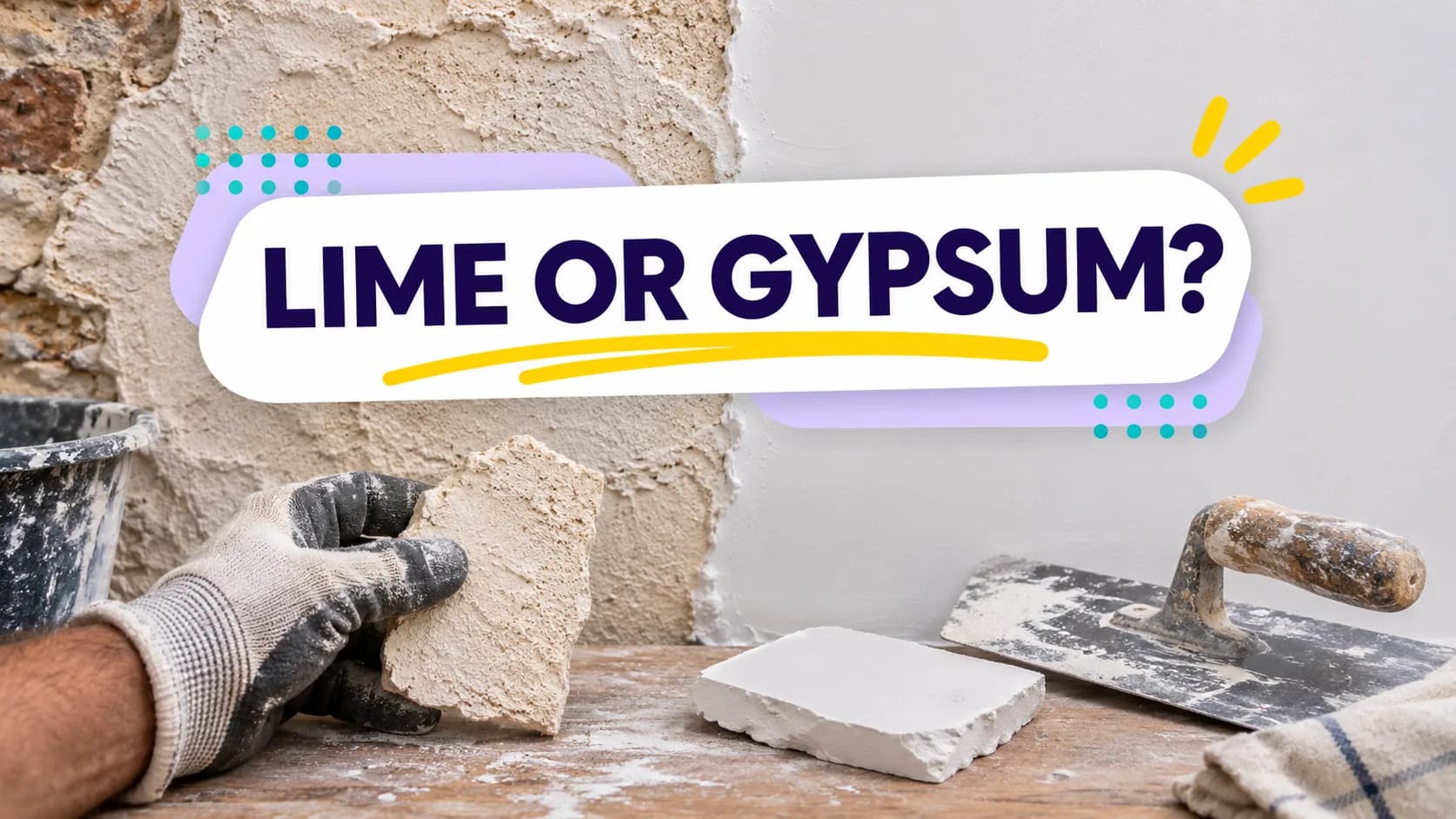
Lime Plaster vs Gypsum: Choosing Materials for Traditional Buildings
In a traditional building, choose plaster to suit the existing construction and its moisture behaviour, rather than selecting by smoothness or drying speed alone. Sound historic plaster should normally be retained. Lime is often appropriate for repairs to traditional lime plaster, while gypsum can be suitable in compatible dry modern systems. Neither material fixes the source of damp.
This guide supports material-selection conversations with a conservation specialist or plaster manufacturer. It is not a plaster mix recipe, application specification or approval to strip historic finishes. The focus is British traditional buildings; local consent requirements and the individual building still need checking.
Inspect the existing plaster before choosing a replacement
SPAB’s lime and clay plaster advice recommends retaining as much existing work as possible and normally matching justified replacements to the original material and coats. Local repairs may be more appropriate than removing an entire wall finish.
Record age, construction, visible defects, previous patches and finishes. Identify whether a problem concerns surface decoration, the plaster body, its attachment or the background. A crack or hollow-sounding area needs interpretation in context; it does not by itself establish that everything should be stripped.
Photograph significant details before intervention. Where the building is listed or historic finishes may be affected, establish the consent position and seek conservation advice first. Ask the specialist to explain what can be retained, what needs repair and what evidence justifies removal.
Understand what the binders do
Lime is a binder used in plasters, renders and mortars. SPAB’s lime guidance distinguishes non-hydraulic lime, which hardens by carbonation, from natural hydraulic lime, which also sets through reactions with water. Increasing hydraulicity generally changes strength, flexibility and permeability; the strongest material is not automatically the best repair.
Non-hydraulic lime putty is commonly relevant to traditional internal plaster. Hydraulic lime is a different material choice, not merely a faster version of an identical finish. Select the binder and aggregate as part of a compatible repair system with the substrate and existing coats.
Gypsum plasters use a different binder and are commonly specified in modern internal systems. ‘Gypsum’ does not describe a complete installation: base coat, finishing product, background preparation and decoration still need to be compatible. Nor does the word ‘lime’ guarantee that every bagged product behaves like a traditional lime-putty plaster.
Compare suitability rather than declaring a universal winner
Use the following comparison to frame the decision. It is an original question set, not a product approval table.
| Decision | Traditional lime repair | Modern gypsum system |
|---|---|---|
| Existing work | Start with matching and conserving significant lime fabric. | Confirm compatibility before introducing it into an older assembly. |
| Background | Assess suction, support and the specified coats. | Use the background and preparation permitted by the selected system. |
| Moisture | Consider drying behaviour and all finishes; investigate water sources. | Confirm the conditions are suitable for the product; do not cover unresolved damp. |
| Programme | Allow for specified curing, protection and decoration readiness. | Use product-specific working and drying requirements. |
| Performance | Assess the complete wall or ceiling assembly. | Check the complete specified system rather than binder alone. |
British Gypsum’s Thistle system specification illustrates the need to define backgrounds and finish requirements. It should not be read as permission to use the system on any historic wall.
Look at moisture and decoration together
‘Breathability’ is shorthand, not a diagnosis. Ask how the wall takes up, stores and releases moisture, and how repairs or coatings may change that behaviour. Resolve leaks, defective rainwater disposal and other moisture sources before expecting a new finish to last.
A vapour-permeable plaster covered by an incompatible coating may not perform as intended. Equally, specifying a breathable paint does not make a saturated or unsound background suitable for plastering. Review the complete sequence from wall to finish.
Our guide to investigating damp and condensation explains why symptoms need a cause-led assessment. Do not select plaster solely from a damp-meter reading or a product marketing term.
Follow the actual product, not a generic lime recipe
Rose of Jericho’s lime-putty guidance describes slow curing, protection and particular background restrictions for its plasters. Those instructions apply to the described products and cannot be transferred indiscriminately to different formulations.
For comparison, Mike Wye’s Heritage Lime Plaster instructions include a particular prepared plasterboard application. The difference is useful: manufacturers can permit different uses for their own complete systems. It is not evidence that either set of instructions can be mixed and matched.
Obtain written confirmation where a product is proposed over an unfamiliar background or old finish. Include preparation, reinforcement where required, coat sequence, environmental protection and decoration readiness. Do not improvise additives to speed setting or follow gypsum working habits on a lime-putty product.
Agree a trial area and acceptance record
Record the existing substrate and finishes, including which historic material will remain.
Set out the proposed products and the manufacturer or conservation advice supporting them.
Agree a representative trial area and what its inspection will assess.
Record texture, junction treatment, condition and curing protection before wider work.
Agree the paint or finish and readiness evidence before decoration.
A trial area helps resolve appearance and workmanship questions, but it does not prove long-term moisture performance. Keep unresolved structural movement, salt contamination or active water ingress in the investigation rather than treating the trial as a cure.
Plan handling, dust and access safely
Lime is caustic and can harm eyes and skin. Use the selected product’s current safety data sheet for handling, protective equipment and first aid. Mike Wye’s 2024 lime-putty SDS identifies skin and respiratory irritation and serious eye damage; it calls for minimising dust, suitable protection and immediate rinsing and medical advice for eye exposure. Confirm that the supplied material matches the sheet. Manufacturer instructions are necessary alongside the risk assessment; this guide does not prescribe a chemical treatment or hot-lime mixing process.
Chalk Down Lime’s product and safety-data directory provides separate sheets for different plasters and lime products. Obtain the sheet that actually matches the material supplied. Some linked files could not be directly fetched during this research, so their detailed instructions are not reproduced here.
Before disturbing old finishes, address asbestos information, concealed services and hazardous dust. HSE’s dust guidance calls for assessment and control; a mask alone is not a dust-control plan. Provide competent access arrangements, particularly for ceilings.
Illustrative example: patch repair in a solid-wall room
A fictional owner wants a quick gypsum skim over a patchy traditional wall. A preliminary review finds mostly sound lime plaster, a recent incompatible patch and a water stain below a defective gutter. The proposed next step is to resolve the water source and obtain a selective repair specification, rather than remove every old coat.
The final repair material remains subject to assessment and a trial. The example demonstrates a sequence of decisions, not a diagnosis for another house.
For related material compatibility, read lime mortar repointing principles. Practitioners can review the Heritage Solid Plastering diploma in relation to their actual work.
Editorial note: AI assisted the research and drafting using the linked primary sources, checked on 17 November 2026. Source alignment and editorial consistency were checked. No independent conservation review, firsthand project evidence or named contributor participation has been verified. The generated featured image illustrates the topic and is not documentary evidence.
Frequently Asked Questions
No. The actual construction, historic significance, background and system matter. Avoid treating a compatible modern internal partition and an old solid wall as the same case.
No. Investigate moisture sources and the complete construction. Material compatibility can help appropriate drying behaviour, but plaster does not repair a leak.
No. The required strength, flexibility, permeability, exposure and existing material determine suitability. A stronger or faster-setting binder may be inappropriate.
No. Assess and retain sound historic work wherever appropriate. Obtain specialist advice before removing significant finishes or where attachment and safety are uncertain.